

PART II — Meeting the Assistants
Chapter 7
Meet ChatGPT
You've Already Been Using It
If you've followed the first six chapters, you may already have been using ChatGPT in the way this book recommends: ask a question, read the response, add context, correct something, and keep the conversation going.
Now it is time to put a name to one of the assistants you are most likely to encounter: ChatGPT.
What Is ChatGPT?
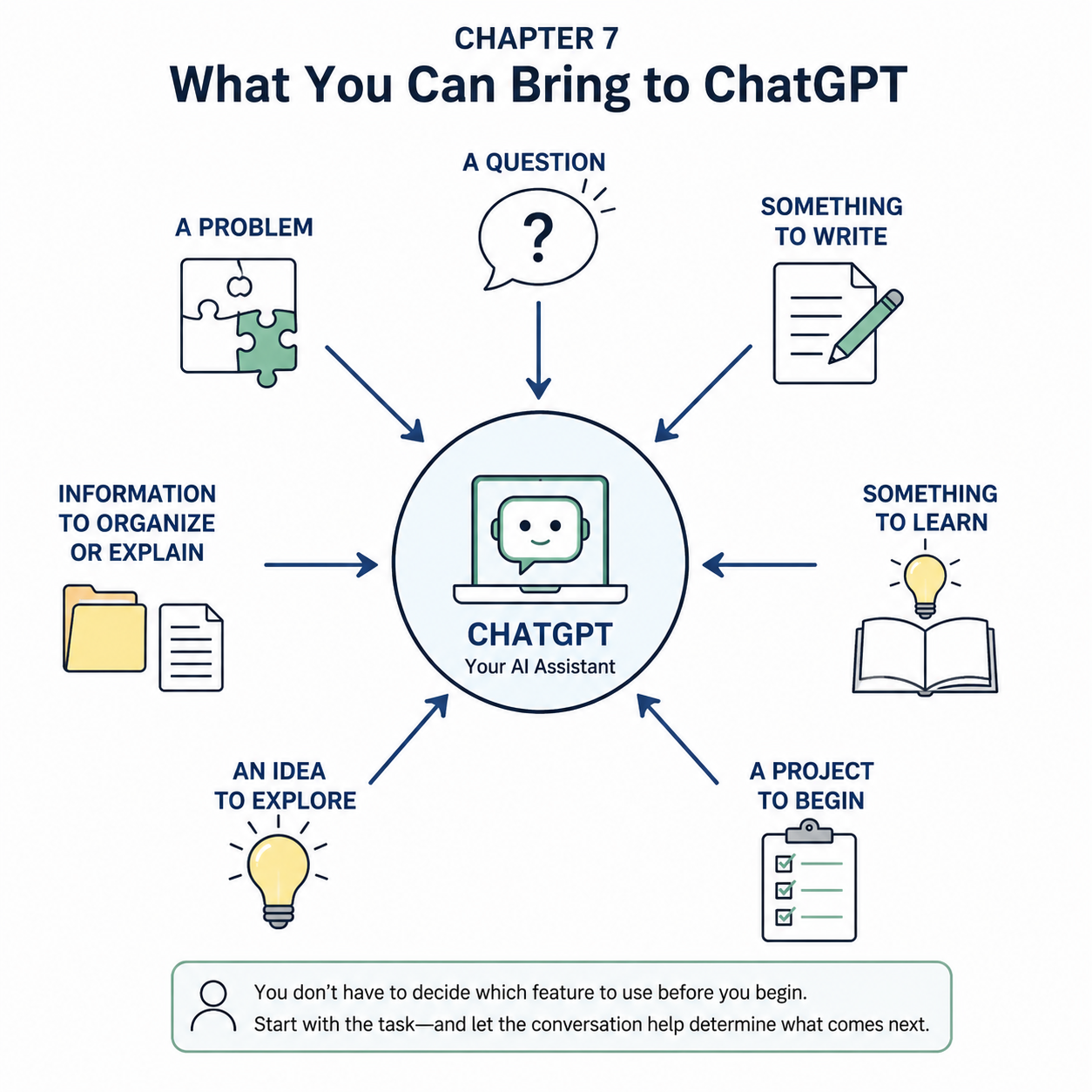
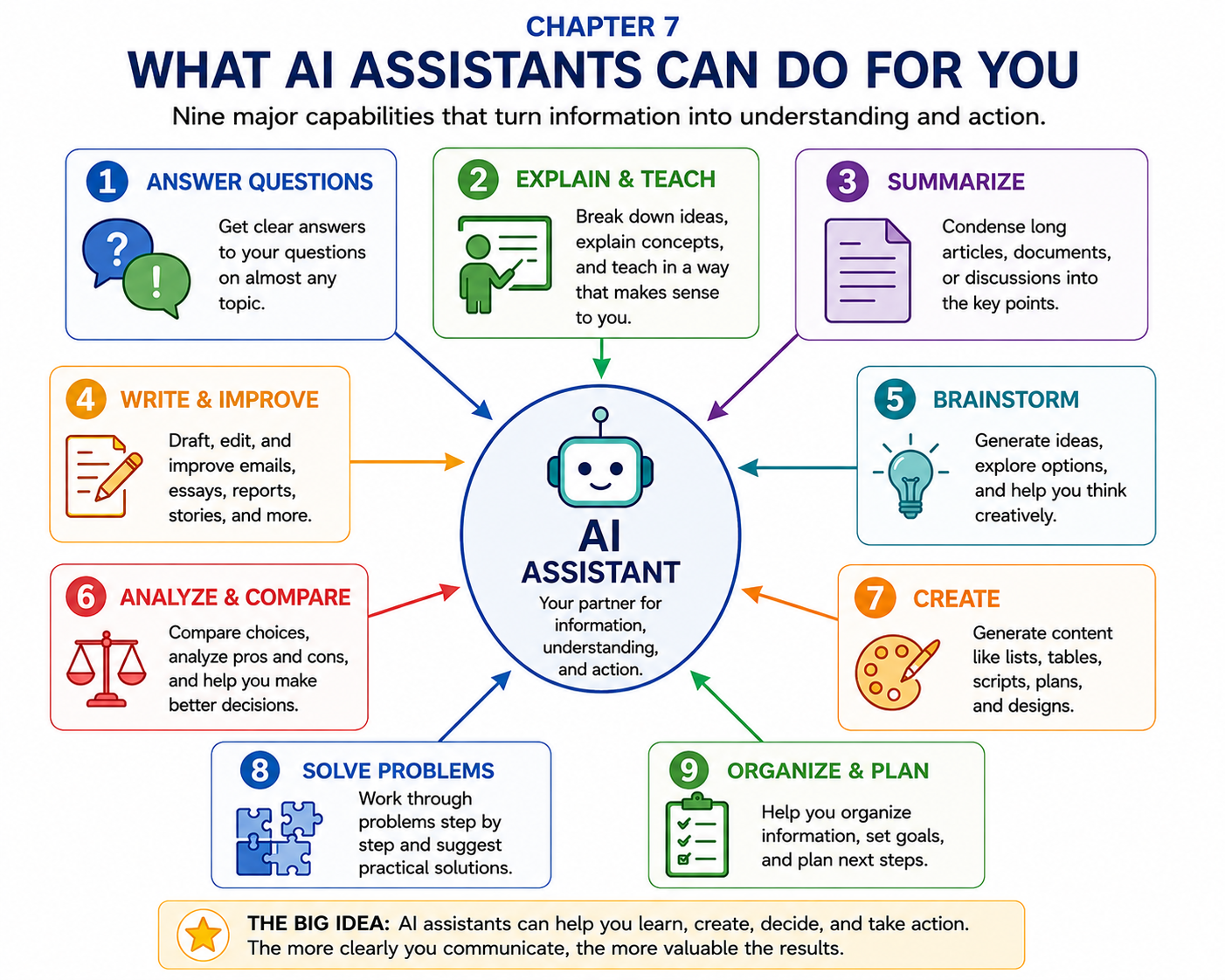
ChatGPT is an AI assistant from OpenAI. It can support conversations, explanations, writing, research, analysis, planning, and many other kinds of work.
That broad range is part of what makes it an interesting place to begin.
You don't have to decide that you are a writer, researcher, programmer, student, or technology enthusiast before you use it. You can simply bring it something you are trying to accomplish.
Sometimes you don't even know exactly what to ask.
Sometimes the first thing you need from AI is help figuring out the question.
Why Start With ChatGPT?
I started with ChatGPT.
That doesn't mean I think everyone should use the same assistant. It means ChatGPT was where my own exploration began.
As I used it, I learned what I found useful, what frustrated me, what kinds of tasks suited it, and what I wanted from an AI assistant.
That experience became more valuable than simply reading a list of features.
Use It for Something Real
The best way to learn an AI assistant isn't to test every feature one by one.
Give it something you actually want to accomplish.
Ask it for help getting started. Have a conversation. Correct it when it makes an assumption. Add information when something is missing. See what happens when you continue the conversation.
Then ask yourself:
Did this help me?
You may discover that ChatGPT is particularly useful for one kind of task and less useful for another. You may discover strengths you hadn't expected. You may discover limitations that matter to you.
That experience tells you something about the technology—and something about yourself.
You Don't Have to Marry Your First AI
Becoming comfortable with one assistant has real value. You learn how it behaves, how much context to provide, and which tasks work well for you.
But familiarity doesn't mean exclusivity.
Other assistants may fit particular tasks or preferences better. One may connect more naturally with services you already use. Another may suit research, writing, programming, or another kind of work.
You don't need to compare them all now.
Start with one. Use it for real things. Learn what you like. Then explore when you have a reason to.
What You'll Discover
The book goes further into:
what ChatGPT is and how to approach it;
how to learn an assistant through actual use;
what kinds of tasks can reveal its strengths;
how to recognize its limitations;
why experience can tell you more than a feature list;
how to decide when another assistant is worth trying.
The chapter also begins a larger discussion: there isn't one AI assistant that has to be right for everyone.
Try It Yourself
Give ChatGPT a real task you have been putting off or a question you genuinely want answered.
Don't worry about finding the perfect wording.
Pay attention to the interaction. Notice what happens when you ask a follow-up question, add information, or correct an assumption.
Then ask yourself what you learned about the assistant and your own preferences.
That is a more useful first step than trying to learn every feature.
Why Read the Book?
Chapter 7 marks the transition from learning how to have a conversation with AI to learning how different AI assistants actually fit into your life and work.
Understanding AI doesn't ask you to become loyal to one product. It gives you a way to evaluate assistants based on what you are trying to accomplish.
ChatGPT is the first assistant we meet.
It won't be the last.
The goal isn't to find the one perfect AI. It is to learn what you want from one—and know how to recognize when another may serve you better.