

PART II — Meeting the Assistants
Book 8
Meet the AI Landscape
ChatGPT Isn't Alone
When I first started using ChatGPT, I naturally treated it as the AI assistant.
That was reasonable. It was the assistant I knew.
Then I began hearing other names.
Claude. Gemini. Copilot. Perplexity. Grok. And there were many more.
At first, that can be confusing. If you've just become comfortable talking with one AI assistant, why would you want to learn another?
The answer is that these assistants aren't simply different names for exactly the same thing. They overlap a great deal, but they have different companies behind them, different ecosystems, different strengths, and different ways of approaching some tasks.
You don't need to learn all of those differences right now.
You just need to know that there is a larger AI landscape than the assistant you happen to be using today.
The Big Names You Are Likely to Encounter
Let's start with the assistants you are most likely to hear about.
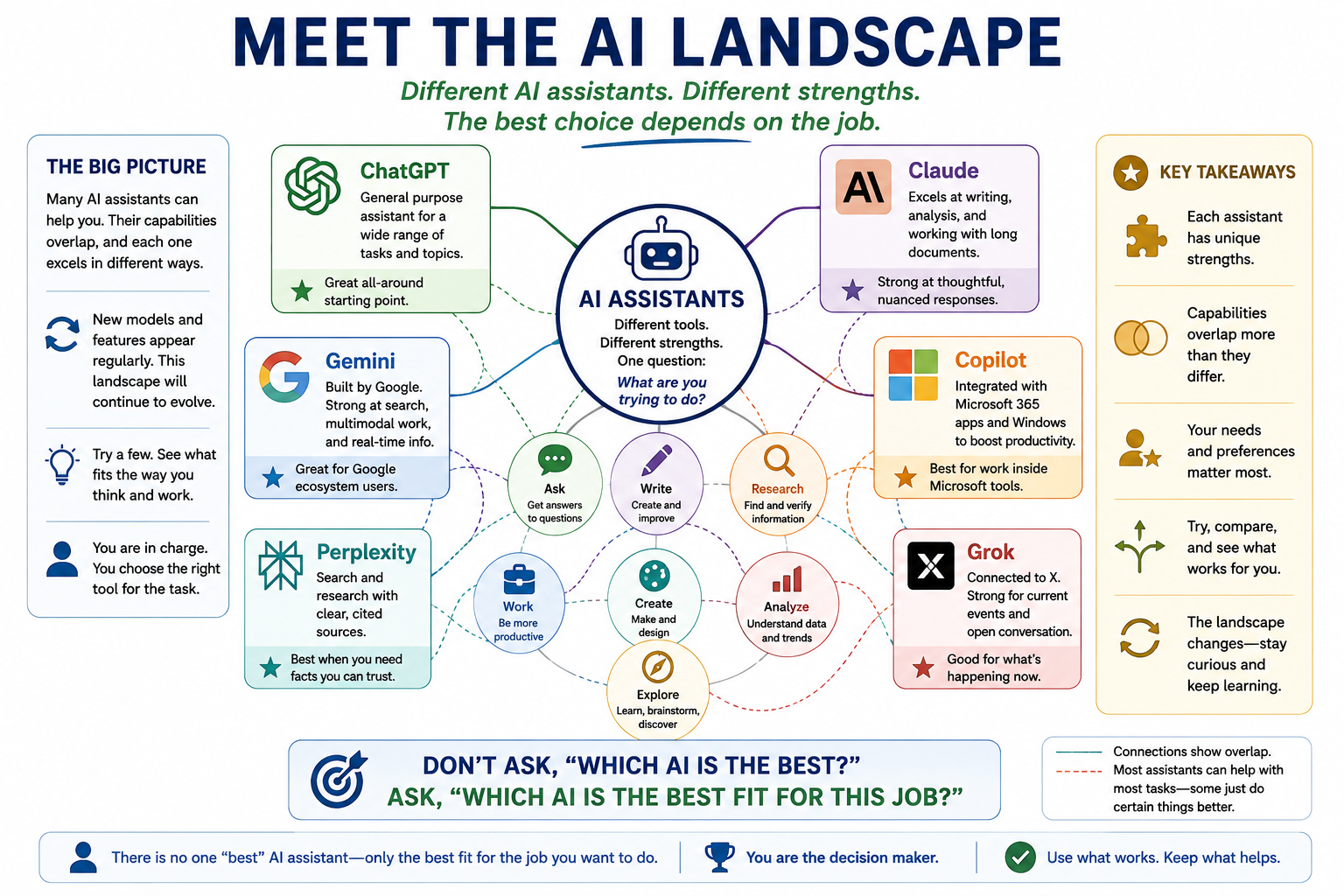
Claude, from Anthropic, is widely associated with writing, editing, long documents, and thoughtful analysis.
Gemini, from Google, has a natural connection to Google's ecosystem and is used across a range of multimodal and educational tasks.
Copilot, from Microsoft, is closely connected with Microsoft products and productivity.
Perplexity has built its identity around research, source discovery, and finding current information.
Grok, from xAI, is another general-purpose conversational assistant, with a particular association with current events and conversational exploration.
And then there is ChatGPT, which we met in the previous chapter, with broad general-purpose capabilities.
Notice something about that list.
The descriptions overlap.
That's intentional.
The assistants are competitors, but they are also converging on many of the same basic capabilities. Each can handle a growing range of tasks, and the differences between them can change over time.
So I don't want you to memorize a table of features.
Instead, start thinking in terms of fit.
There Isn't One AI for Everything
Suppose you asked five experienced people to recommend a car.
One might ask how far you drive. Another might ask whether you have children. Someone else might care about fuel economy, cargo space, performance, or price.
There wouldn't necessarily be one universally correct answer. The right choice would depend on what you wanted the car to do.
AI assistants are similar in that respect.
If most of your work takes place in Google's services, an assistant closely connected with that ecosystem may be attractive.
If your work involves extensive writing and long documents, another assistant may appeal to you.
If research and sources are central to what you do, you may want to explore an assistant that places particular emphasis on source discovery.
If you spend most of your day in Microsoft 365, an assistant connected with that environment may make sense.
The question isn't:
"Which AI is the best?"
A better question is:
"Which AI is best suited to what I want to do?"
That distinction will become more important later in the book.
The AI Landscape Is Bigger Than North America
Most American readers will first encounter the names coming from companies they already know.
But AI development isn't limited to the United States.
Europe has important AI companies of its own. Mistral AI, based in France, is one example. Aleph Alpha, based in Germany, is another.
Asia has an even larger collection of significant AI efforts. DeepSeek, Qwen from Alibaba, ERNIE from Baidu, Kimi from Moonshot AI, MiniMax, and Doubao from ByteDance are among the names a reader may encounter.
Some are aimed primarily at particular languages or markets. Some emphasize research or coding. Some have broad consumer applications. Their importance isn't limited to whether an American reader is likely to use them every day.
They are part of the larger picture.
And that larger picture matters for one reason in particular:
You should be careful about assuming that today's familiar names will define AI forever.
Open Source Changes the Picture Again
There is another group worth knowing about: open models and the communities that build around them.
Names such as Llama, Mistral's open models, Gemma, and Qwen can appear in discussions about running models locally, experimenting with them, or building applications around them.
That may sound far removed from the way most beginners use AI.
For many readers, it probably is.
You don't need to install a model on your computer to benefit from knowing that these options exist.
Their existence tells us something about the structure of the AI field. There isn't just a handful of companies offering finished assistants to consumers. There are researchers, developers, companies, and open communities working with models in different ways.
The AI landscape is therefore much larger than the chat window you see on your screen.
Different Assistants Can Give Different Answers
Here's where this becomes interesting for someone who is already comfortable using AI.
Suppose you ask ChatGPT a question and receive an answer that seems reasonable.
You could ask another assistant the same question.
The second answer might be very similar.
Or it might organize the information differently. It might emphasize a different consideration. It might ask you for more context. It might approach the problem from a different perspective.
That doesn't automatically mean one answer is better.
It gives you another perspective.
This can be especially useful for important questions.
If you're making a significant decision, comparing answers from two assistants can reveal assumptions that you didn't notice in the first answer.
That is a use of multiple AI assistants that I find much more interesting than simply collecting them.
You don't need another AI because it has a different logo. You may want another perspective.
How Another AI Might Answer
This is a feature we'll use occasionally throughout the book.
Suppose we asked two assistants:
"I have a large collection of old family photographs. I want to digitize and organize them so my family can find them years from now. Where should I begin?"
One assistant might start by asking about the number and format of the photographs.
Another might begin with the question of who will use the collection and what kinds of searches they will want to perform.
A third might focus first on preservation and backup.
None of those approaches has to be wrong.
Each may reveal a different part of the problem.
The lesson isn't that you need to ask every question to five different assistants. The point is to notice when a second perspective could be useful.
A second perspective can be useful.
Don't Turn This Into a Contest
It is tempting to ask:
"Which one wins?"
Technology discussions often turn into contests. People choose sides, defend their favorite product, and look for evidence that their choice is superior.
That can be entertaining.
It isn't especially useful for learning how to use AI.
The assistants will continue to change. Capabilities will be added. Some differences will become less significant. Other differences will emerge.
The assistant that fits your needs today may not be the one you prefer later.
You don't need to predict that.
You can simply learn how to recognize a good fit when you encounter one.
A Simple Way to Think About the Choices
For a practical guide to choosing among AI assistants, see Appendix A — Choosing an AI Assistant.
For now, you can keep the landscape in your head with a few broad categories.
If you want a general-purpose assistant, ChatGPT, Claude, Gemini, and Grok are examples worth knowing.
If research and sources are central, Perplexity is one of the names to investigate.
If your daily work is deeply connected to Google, Gemini may deserve attention.
If your work centers on Microsoft 365, Copilot may be a natural candidate.
If you want to explore open models, names such as Llama, Mistral, Gemma, and Qwen will appear.
Those aren't permanent labels or rankings. They are simply starting points for exploration. Capabilities change, and an assistant may move into a new area faster than you expect.
Want more detail?
The appendices include a more extensive comparison of the major AI assistants, their strengths, typical uses, and features. That information can be updated as the assistants change.
You Don't Need to Try Them All
This may be the most reassuring part of the chapter.
Then, when you have a reason to try something else, try it.
Perhaps you want to see whether another assistant handles a long writing project differently. Perhaps you want to compare research answers. Perhaps you already spend most of your day in Google's or Microsoft's software and want to see what an integrated assistant feels like.
Give it a real task.
Then judge the experience for yourself.
That is far more useful than reading twenty pages of feature comparisons.
The AI Landscape Will Keep Moving
For a broader reference to the global AI assistant marketplace, see Appendix C — The Global AI Assistant Marketplace.
One reason I'm reluctant to declare a permanent winner is simple: the field doesn't stand still.
New assistants appear. Existing assistants change. Companies add capabilities. Open models improve. Services that once seemed unrelated begin to overlap.
The boundaries are becoming less fixed.
That means the skill worth developing isn't memorizing today's rankings.
It is learning how to evaluate an assistant against the work you actually want to do.
That's a skill that will remain useful even when the names change.
Take This With You
You don't need to choose among all of them today.
You've already done something more valuable.
You've learned how to have a productive conversation with one AI assistant.
Now you know that there are others.
And when you have a reason to explore them, you'll know what to look for.