

PART II — Meeting the Assistants
Book 7
Meet ChatGPT
You've Already Been Using It
There's something slightly unusual about beginning this chapter.
If you've been following along and trying some of the conversations we've discussed, you may already have been using ChatGPT. You may have asked it a question, followed up when the answer wasn't quite what you wanted, added some context, and perhaps discovered that the conversation led you somewhere you hadn't expected.
So why stop now and formally introduce it?
Because knowing how to use an AI assistant and knowing which assistant you're using are two different things.
Until this point, we've deliberately kept the focus on the conversation. Those ideas apply to many AI assistants. Now it is time to put a name to one of the assistants you are most likely to encounter.
ChatGPT.
What Is ChatGPT?
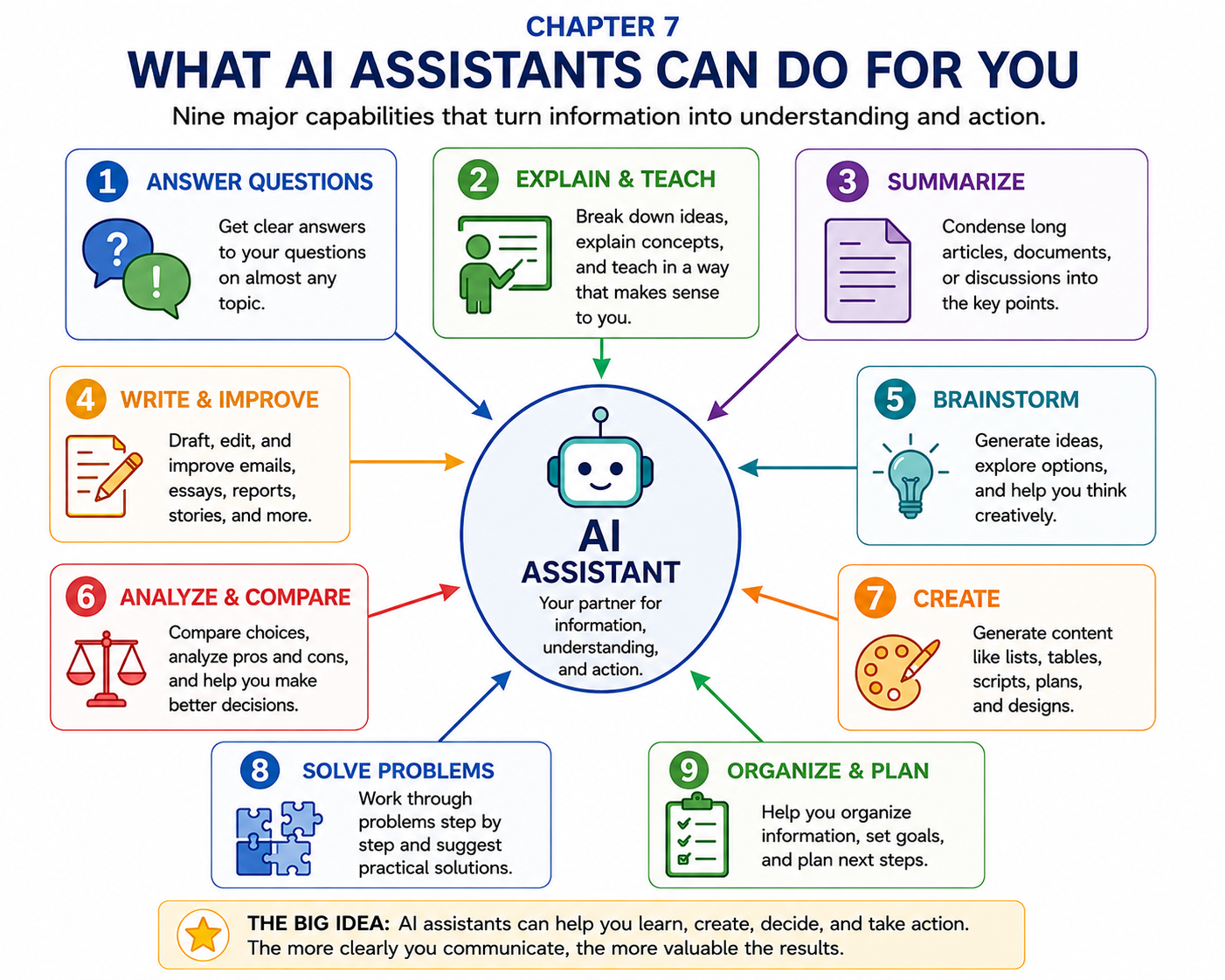
ChatGPT is an AI assistant from OpenAI. You can have conversations with it, ask questions, request explanations, work with writing, explore ideas, analyze information, and use it for many other tasks.
That description is intentionally broad.
ChatGPT is broad enough that a person can approach it without first deciding what kind of AI user he or she is going to be. You don't have to be a writer, researcher, programmer, student, business owner, photographer, or technology enthusiast.
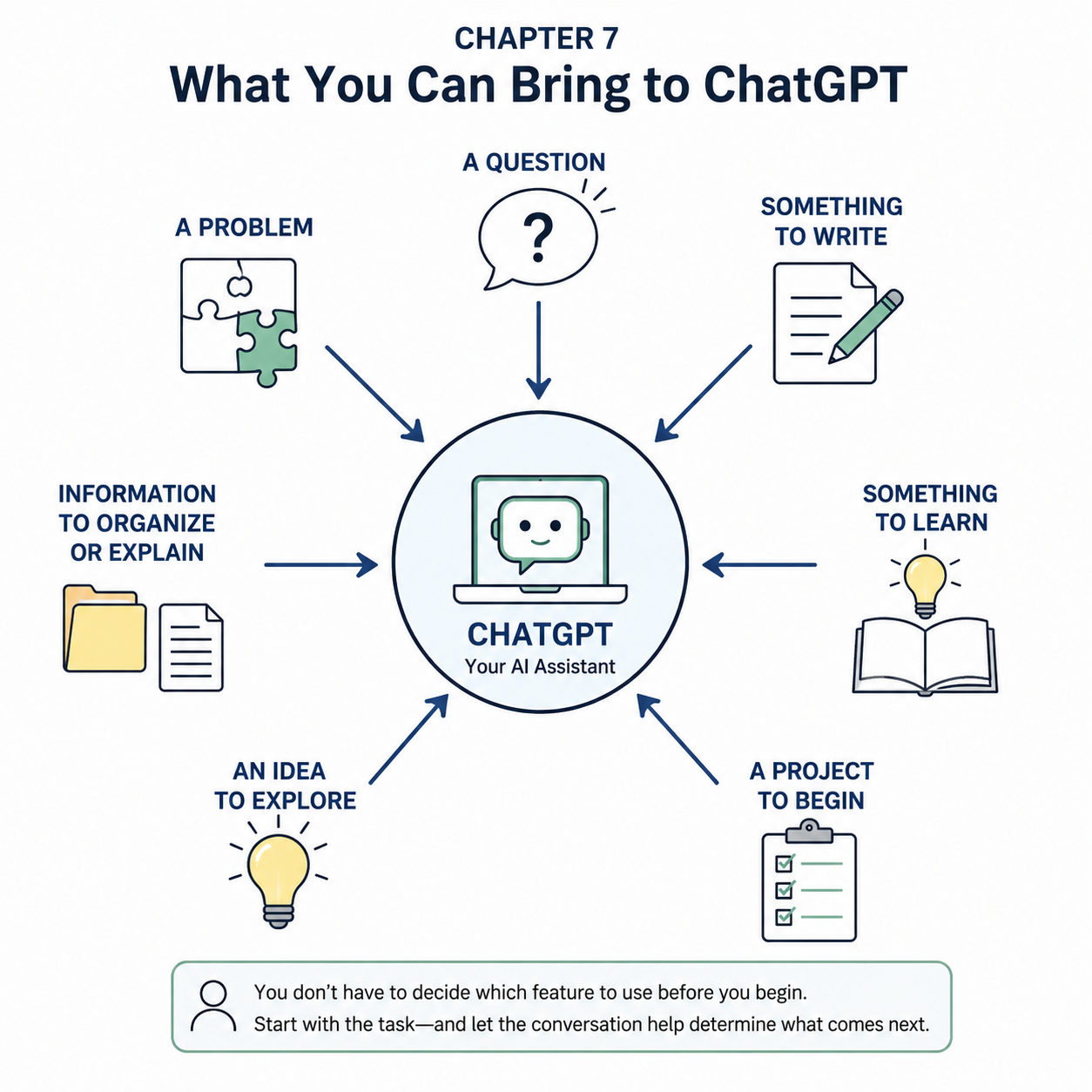
You can simply bring it something you're trying to accomplish.
That might be something important, such as planning a project or learning a difficult subject. It might be something ordinary, such as figuring out what to cook for dinner or deciding how to organize a collection of photographs. It might even be something you aren't sure how to ask.
And that last category may be one of the most useful.
Sometimes the first thing you need from AI isn't an answer.
You need help figuring out what question to ask.
Why Start With ChatGPT?
I started with ChatGPT.
That is worth telling you, not because I think you should necessarily do the same, but because it is part of my own experience with AI. ChatGPT was the assistant through which I first began exploring what these systems could do. As I used it, I learned what I found useful, what I wanted to do differently, and what questions I wanted to ask next.
That experience is part of why I suggest starting with one capable, general-purpose assistant. You learn more by actually using one than by trying to compare a dozen before you've really used any.
There are many good AI assistants, and this book will introduce several of them. I am not suggesting that ChatGPT is the one assistant everyone should use.
There is a simpler reason for starting here.
If you're new to AI, begin with one capable, general-purpose assistant and learn what you actually want from it.
You need somewhere to begin.
Once you have some experience, the question changes from "Which AI should I use?" to something much more useful:
"What do I want my AI assistant to help me do?"
That is a question you can answer from experience rather than from a comparison chart.
Start With Something You Actually Need
When we get a new piece of technology, many of us learn the features first and find a use for them later. AI can be approached differently.
We open the settings. We look at the menus. We read about capabilities. We watch demonstrations. We may spend considerable time learning what the technology can do before asking what we actually want it to do.
Start with something real.
Suppose you have a decision you've been putting off. Ask ChatGPT to help you think through it. Tell it what you know, what concerns you, and what you are trying to decide.
Or perhaps there is something you've never quite understood. Ask for an explanation in language appropriate for someone who knows very little about the subject. If the explanation doesn't make sense, say so. Ask for an example. Ask it to explain the idea another way.
Maybe you've written something and aren't sure whether it says what you intended. Give it to ChatGPT and ask what a reader might misunderstand.
In each case, you're doing something more useful than testing a feature.
You're finding out how an AI assistant fits into your own way of thinking and working.
Your Experience Will Tell You More Than a Feature List
As you use ChatGPT, you'll begin to notice things.
Perhaps you find that it is particularly useful for helping you get started when you're stuck. Maybe you discover that it is good at turning a collection of scattered thoughts into an organized outline. You may find that having someone—or something—to question your assumptions is useful when you're making a decision.
You may discover limitations, too.
An answer may sound convincing and still need to be checked. An explanation may be technically correct but not suited to what you were trying to accomplish. A response may take you in a direction that looked promising but turned out not to be useful.
Those experiences are part of learning to use AI well.
You are learning both what the assistant can do and how you want to use it.
That distinction matters.
The first is about the technology.
The second is about you.
You Don't Have to Marry Your First AI
Once you become comfortable with ChatGPT, you may find yourself returning to it simply because you know how it works and how you like to interact with it.
That's perfectly reasonable.
Familiarity has value. You learn how to phrase things. You learn when to provide more context. You learn which kinds of tasks are a good fit. You develop expectations about what happens when you ask a question.
But don't confuse familiarity with exclusivity.
There are other major AI assistants, and some may fit particular tasks or preferences better. One may work especially well with services you already use. Another may suit research. Another may appeal to you for writing or programming.
You don't have to decide that today.
In fact, you are better prepared to compare them now that you have some experience with one assistant.
A Small Experiment
If you're using ChatGPT now, try something you've actually been wondering about.
Don't construct a perfect prompt.
Don't worry about whether you're using the "right" words.
Just tell ChatGPT what you're trying to accomplish.
Then see where the conversation goes.
If the first answer isn't quite right, tell it what is missing. If it makes an assumption that isn't correct, correct it. If its answer raises another question, ask that question.
After a few exchanges, stop and think about the experience. You are learning what you want from an AI assistant, not merely testing what it can do.
Did it help?
What did you like?
What frustrated you?
What did you wish it could do?
Those answers are more useful to you than knowing that one assistant has a particular feature another assistant doesn't have.
They begin to tell you what you need from AI.
One Good AI Is Enough to Begin
Start with one.
Use it for real things.
Learn what you like.
Notice what you don't like.
Then, when you're ready, try another.
By doing that, you'll be in a much better position to recognize the differences between AI assistants. You won't be comparing them as abstract products. You'll be comparing them based on experiences you've had and tasks you actually want to accomplish.
And that brings us to the next question.
If ChatGPT is one place to begin, what else is out there?
When a More Detailed Prompt Helps
There will be times when a more carefully constructed prompt really is useful.
If you're asking AI to analyze a large collection of information, produce a particular format, follow a complicated set of requirements, or perform a repeatable task, giving it detailed instructions can save time.
That's worth learning.
But those are skills we'll develop later. For now, I want you to avoid a common trap: thinking that effective AI use is primarily about discovering the secret wording that makes the machine produce the perfect answer.
It isn't.
The goal isn't the perfect prompt. The goal is a useful result.
Sometimes the fastest route to that result is a carefully written request. Sometimes it's a five-minute conversation. Often, it's both.
What you'll take away:
Conversation is a skill
You don't have to get the first question right.
Let the answer shape the next question
What you learn from one response can help you ask a better question.
Context can reveal the real problem
The problem you start with may not be the problem you actually need to solve.
You can change your mind
You can correct, redirect, or completely restart the conversation.
A useful result matters more than a perfect prompt
Sometimes a detailed prompt is helpful. Sometimes a conversation is the better tool.
Try This
Use ChatGPT for something you actually need today.
Choose a real task—not a test question.
Tell ChatGPT what you're trying to accomplish. Give it enough context to get started.
Then have a short conversation. Correct it if it misunderstands you. Add information if something is missing. Ask a follow-up question if the answer raises one.
After a few exchanges, ask yourself:
Did it help?
What did I learn about what I want from an AI assistant?
What would I want an AI assistant to do differently?
You are learning about the assistant by using it for something that matters to you.