

PART I — Learning How to Work With AI
Book 6
Conversation Beats Prompting
You Don't Have to Get It Right the First Time
By now, you've probably noticed something about using AI. Your first question doesn't have to be perfect. You can ask something, see the answer, and then decide what you really wanted to know. You can add information, correct a misunderstanding, ask for a different explanation, or change direction completely.
That's more than a convenient feature. It changes the way you should think about using AI.
You don't have to treat every request as a carefully constructed command that must produce the perfect answer on the first try. You can have a conversation.
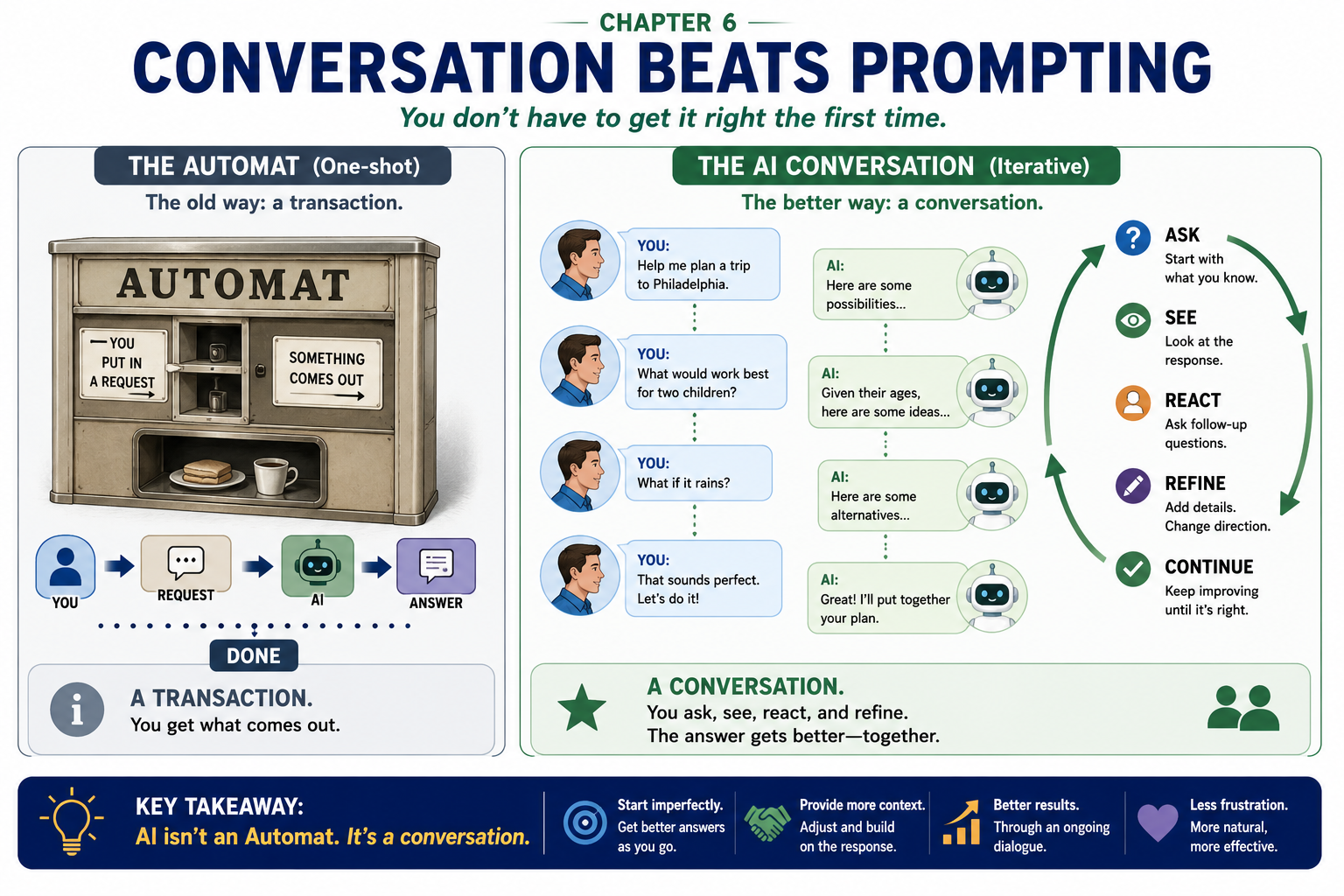
AI Isn't an Automat
If you remember Philadelphia's Automat, you may remember the rows of small glass-fronted compartments containing sandwiches, pies, coffee, and other food. You selected what you wanted, paid for it, opened the little door, and took it.
There was no conversation.
That is a useful way to think about the difference between a transaction and a conversation with AI.
You ask for something. The AI gives you something. But unlike the Automat, you don't have to walk away with whatever came out of the compartment.
"That's not quite what I meant."
"Let's approach that differently."
"I like the second idea, but change this part."
"You've misunderstood what I'm trying to accomplish."
And then you can continue.
AI isn't an Automat. It's a conversation.
The First Answer Gives You Something to Work With
I remember taking my younger sister and brother on a train ride to Philadelphia when they were children. The train ride itself was part of the adventure, but looking back, I wish we had done more planning about what we would actually do once we arrived. We knew where we were going. We hadn't thought enough about what would make a good day for children their ages.
Today, I might approach that planning differently.
I could tell an AI assistant that I'm taking two children to Philadelphia by train, give their ages, tell it how long we'll be there, and describe the things they enjoy. Then I could ask it to suggest a realistic day that balances activities with the time and energy of two children.
I could keep refining the conversation:
"What would they find most interesting?"
"What should we skip?"
"What happens if it rains?"
"How much walking is involved?"
"What could we do near the train station?"
The difference isn't that AI magically knows what makes a good family outing. The difference is that I can give it the context I didn't have—or didn't think to consider—when I made that trip years ago.
The original question doesn't have to contain everything. It can give you something to work with.
Let the Answer Teach You What to Ask Next
This is one of the most interesting things about conversational AI.
Sometimes you don't know the next question until you see the answer to the current one.
You may ask about a new subject and encounter a term you've never heard before. Now you have a question you couldn't have asked five minutes earlier.
You may ask for recommendations and discover that there are two fundamentally different approaches. Now you can ask which approach fits your situation.
You may ask AI to help you solve a problem and discover that you were solving the wrong problem.
That is why conversation can be so useful.
The answer changes what you know, and what you know changes the next question.
Conversation Can Reveal the Problem Behind the Problem
I have another example from my own life.
Over the years, I accumulated a large collection of slides that I had taken and developed in my darkroom. They represented a lot of time, effort, and memories, and I didn't want to lose them.
At first, the problem seemed straightforward:
“How can I digitize all those slides?”
But digitizing them would only solve the first problem.
Once I had hundreds or perhaps thousands of digital images, how would I organize them so that I could actually find something later?
That changes the question.
I might begin an AI conversation by saying:
“I have a large collection of 35mm slides that I developed myself. I want to preserve them digitally. What are my options?”
The answer might lead me to questions I hadn't considered.
What quality should I scan at? Should I do it myself or use a service? What file format should I use? How much storage will I need? How should I name the files? Should I organize them by date, subject, event, or location? What information should I preserve with each image? How should I back everything up?
And then I might realize that retrieval is just as important as preservation.
I don't merely want a digital pile of slides. I want to be able to say, years from now, “Show me the pictures we took on that trip,” and actually find them.
That could lead to another conversation:
“Help me design a system for organizing these images so I can find them easily years from now.”
The first question led to another question, which led to another.
The conversation helped me discover the problem I was really trying to solve.
You Can Change Your Mind
There's another advantage to conversation.
You can change your mind.
Suppose you begin by asking:
“What's the best way to organize all of my digital photographs?”
After discussing the possibilities, you realize that your real goal isn't perfect organization. You simply want to be able to find photographs of your family when you want them.
So you tell the AI:
“I've been thinking about this differently. I don't need a perfect filing system. I need something simple that I'll actually maintain.”
That's a much better definition of the problem.
And it may lead to a completely different recommendation.
The AI didn't magically discover the answer. The conversation helped you discover what you actually wanted.
You don't have to defend your first question.
You Don't Have to Defend Your First Question
This may be one of the most liberating ideas in the book.
Your first question is allowed to be incomplete. It is allowed to be vague. It is allowed to contain an assumption that turns out to be wrong. It is allowed to change.
You don't have to defend it.
“I've thought about that differently.”
“I left out something important.”
“Let's start over. Here's what I'm really trying to do.”
That's not failure.
That's conversation.
Chapter 5 focused on asking a better question. Chapter 6 adds the next idea: you can let the conversation help you discover the better question.
A Conversation Can Get Better One Step at a Time
Think about how people solve complicated problems together.
They rarely begin with a complete description of everything that matters. Someone proposes an idea. Someone else asks a question. A new fact comes to light. The idea changes. Another possibility appears. The group realizes that an assumption was wrong.
Eventually, the problem becomes clearer.
A useful AI conversation can work much the same way.
You don't have to know the entire path at the beginning. You need enough of a starting point to take the next useful step.
Then another.
Then another.
When a More Detailed Prompt Helps
There will be times when a more carefully constructed prompt really is useful.
If you're asking AI to analyze a large collection of information, produce a particular format, follow a complicated set of requirements, or perform a repeatable task, giving it detailed instructions can save time.
That's worth learning.
But those are skills we'll develop later. For now, I want you to avoid a common trap: thinking that effective AI use is primarily about discovering the secret wording that makes the machine produce the perfect answer.
It isn't.
The goal isn't the perfect prompt. The goal is a useful result.
Sometimes the fastest route to that result is a carefully written request. Sometimes it's a five-minute conversation. Often, it's both.
What you'll take away:
Conversation is a skill
You don't have to get the first question right.
Let the answer shape the next question
What you learn from one response can help you ask a better question.
Context can reveal the real problem
The problem you start with may not be the problem you actually need to solve.
You can change your mind
You can correct, redirect, or completely restart the conversation.
A useful result matters more than a perfect prompt
Sometimes a detailed prompt is helpful. Sometimes a conversation is the better tool.
Try This
Take a question you might normally ask AI.
Instead of spending several minutes trying to construct the perfect prompt, ask it naturally. Read the response, then ask yourself:
What did I learn from that answer?
Use that information to ask your next question.
Continue for three or four exchanges. Don't try to impress the AI or sound technical. Just have the conversation.
At the end, ask:
“Based on our conversation, what do you think I'm really trying to accomplish?”
Read the answer carefully.
You may find that the AI has identified something you hadn't quite put into words yourself. Or it may get it wrong.
Either way, you now have something useful to react to.