

PART I — Learning How to Work With AI
Book 5
Asking Better Questions
The Question Shapes the Answer
By now you have seen that you don't need magic words to use AI. You have seen that a conversation can improve as you add information.
That leads to a simple idea that will serve you throughout this book:
The quality of the question helps shape the quality of the answer.
You don't need to become an expert question writer. Before asking AI for an answer, it helps to think for a moment about what you really want to know.
“What's Good?” Is Usually the Wrong Question
Suppose you ask:
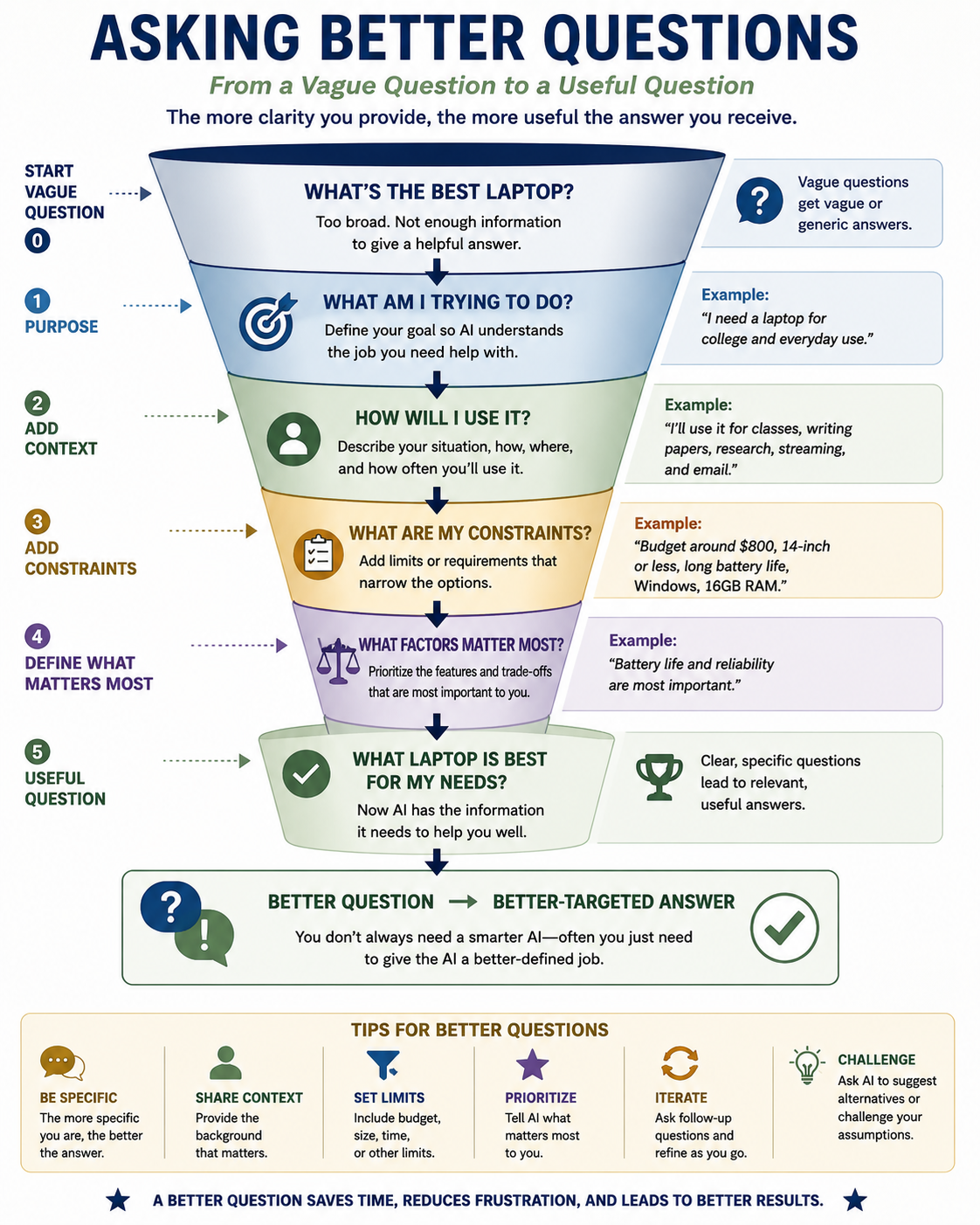
“What's the best laptop?”
It sounds like a reasonable question. But best for whom?
A college student might care about battery life and weight. A photographer might care about screen quality and storage. A gamer might care about graphics performance.
The AI can give you a list of highly rated laptops. That may be useful. But it cannot know which meaning of “best” matters to you unless you tell it.
A better question is often: “What's best for me?”
Ask AI What You Are Missing
Sometimes you know enough to describe a situation, but not enough to know which facts matter.
One of the most useful questions you can ask is:
“What important questions haven't I asked yet?”
AI can help you improve the question before it tries to improve the answer.
Give AI a Job, Not Just a Topic
A topic tells AI what subject interests you. A job tells it what you want done.
Compare:
“Retirement travel.”
with:
“Help me plan a one-week retirement trip in October for two people who enjoy history, museums, and good food, but don't want a schedule packed from morning to night.”
The first gives the AI a topic.
The second gives it a task.
When you tell AI what you want it to do, it has a better target.
Constraints Can Help
People sometimes think constraints make an AI request harder. Often they make the job clearer.
If you ask for a dinner menu, telling AI that one guest is vegetarian, another has a food allergy, and you want to stay within a certain budget gives it useful boundaries.
A good constraint can help AI give you a more useful answer.
Ask for Alternatives Before You Choose
When you're making a decision, don't ask AI for only one answer.
Ask:
“Give me three reasonable approaches and explain the trade-offs.”
Then ask:
“Make the strongest case against my preferred option.”
AI can give you another perspective before you commit.
What you'll take away:
Great answers usually begin with useful questions
The question helps define the task.
Make the question personal
Give AI the information that matters to your situation.
Ask what you're missing
“What important questions haven't I asked yet?” can reveal things you hadn't considered.
Give AI a job, not just a topic
Tell it what you want done.
Ask for alternatives and challenges
Trade-offs and arguments against your first choice can improve your thinking.
Try it yourself
Think of a decision you expect to make soon. It can be something small—a purchase, a meal, a weekend activity—or something larger.
Ask AI the question exactly as it first occurs to you.
Then ask:
“What information about my situation would help you give me a better answer?”
Next ask:
“What important questions haven't I asked?”
Then ask:
“What are the strongest arguments against your recommendation?”
Compare the final response with the first one.
The biggest improvement may not have come from a better prompt. It may have come from a better question.