

PART I — Learning How to Work With AI
Book 4
The Prompt Myth
You Don't Need the Magic Words
Once people discover that AI assistants respond to written instructions, a new question often appears:
What is the right prompt?
There are books, courses, websites, and social-media posts promising better prompts. Some offer useful techniques. But the idea that there is a secret combination of words that unlocks AI is misleading.
There is no magic prompt.
A good prompt can improve an answer. A good conversation can improve it even more.
The goal isn't to write a perfect first message. It is to give the AI enough information to understand what you are trying to accomplish—and then keep working with it.
Start With the Job
Suppose you ask:
"Write an email about the meeting."
That isn't a terrible request. It simply leaves a lot unanswered.
Which meeting? Who is receiving the email? What happened? What do you want the reader to do? What tone should it have?
A more useful request describes the job:
"Write a short email to the three people who attended yesterday's planning meeting. Thank them for their ideas, mention that we agreed to meet again next Tuesday, and ask them to send me any additional suggestions before then. Keep the tone friendly and professional."
Notice what changed. There was no secret formula. The request simply described the job.
Start with what you are trying to accomplish.
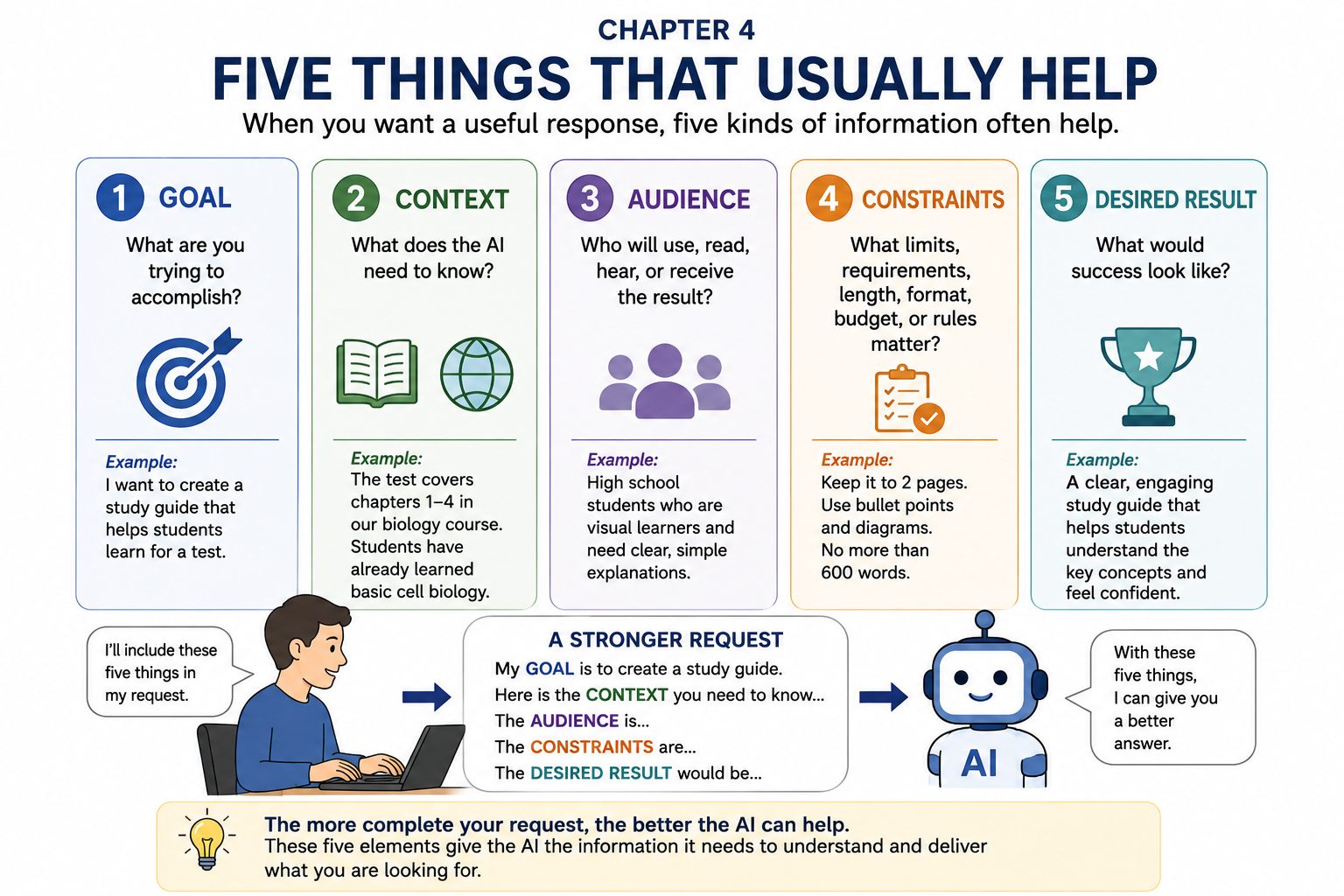
Five Things That Usually Help
When an AI response isn't quite what you need, five kinds of information can often help:
Goal — What are you trying to accomplish?
Context — What does the AI need to know?
Audience — Who will use, read, hear, or receive the result?
Constraints — What limits or requirements matter?
Desired result — What would a successful answer look like?
You don't need all five every time. Think of them as a checklist for your thinking, not a form you must complete.
Often, the AI can even help you discover what information is missing.
The Conversation Does the Rest
Suppose the AI drafts your email, but it sounds too formal.
"That sounds too formal. Make it warmer and more like something I would actually write."
Perhaps it is still too long.
"Cut it to about 100 words."
Then you notice something is missing.
"Add a sentence asking everyone to bring their notes from yesterday's meeting."
You have now produced a much better result without writing a sophisticated prompt.
You improved the answer by improving the conversation.
Good Prompting Is Good Communication
A Prompt Is a Tool. Communication Is the Skill.
There are times when a carefully prepared prompt really does matter. A complex task may require substantial context, a particular format, specific requirements, or information the AI would otherwise have to guess.
Prompt engineering is real, and people who build AI systems use sophisticated techniques for consistency, formatting, automation, and other purposes.
For everyday AI use, though, you don't need to learn a secret AI language.
You need to communicate clearly.
What you'll take away:
There is no magic prompt
A good first request helps, but you can improve the result through conversation.
Start with the job
Tell the AI what you are trying to accomplish.
Give relevant context
Information about the situation, audience, constraints, and desired result can make the response more useful.
Treat the first answer as a draft
You can ask for changes, clarification, another approach, or a different perspective.
Ask the AI what it needs
If you're unsure how to formulate your request, ask the AI what information would help.
Try it yourself
Take something you actually need help with today.
First, give the AI a short request.
Then give it more context and compare the result.
Finally, continue the conversation with at least two follow-up questions.
For example:
"Help me write an email about my appointment."
Then:
"Help me write a short email to my dentist asking to move my appointment from Thursday to Friday. Keep it friendly and say that Friday afternoon works best for me."
Then:
"Make that sound more natural and less formal."
Afterward, ask:
"What information could I have given you that would have produced a better result?"
You are learning how to communicate with AI by using AI.