

PART I — Learning How to Work With AI
Book 3
Why AI Feels Different
We're Used to Searching for Answers
For most of us, the Internet taught us a particular way of finding information. We type words into a search box. The search engine gives us results. We look through those results and decide which one might contain what we need.
If the first search doesn't work, we try another search.
That works remarkably well. It also creates a habit that can get in the way when we begin using AI.
We may assume that an AI assistant is simply a more sophisticated search engine.
It isn't.
Search Finds. AI Can Search, Then Develop.
Suppose you are planning a trip to Yellowstone National Park.
You might type:
"Tell me about Yellowstone National Park."
A search engine can give you pages about Yellowstone. You can examine those pages, compare sources, and decide which information is useful.
An AI assistant can give you an overview in a conversation.
Then you can continue:
"I'm traveling with my grandchildren."
"We'll be there for three days."
"We enjoy easy hikes."
"Help me build an itinerary."
The first question wasn't wrong. It simply wasn't the whole question.
Each follow-up added information that changed what a useful answer would look like.
Chapter 3 explores what happens when we move from finding information to working with it through conversation. Context, follow-up questions, corrections, and different perspectives can change the usefulness of an AI response.
The difference isn't simply search versus AI. It is what happens after information is found. Search can give you information. Conversation can help you work with it.
The First Answer Isn't the Destination
This may be one of the biggest adjustments for someone who has spent years using search engines.
With search, you often want to find the answer and leave. With AI, the first answer can be the beginning of the work.
You can say:
"That's more complicated than I need."
"Give me an example."
"That's not quite what I meant."
"Let's approach this from another perspective."
"What questions should I be asking?"
Search helps you find information. Conversation helps you work with it..
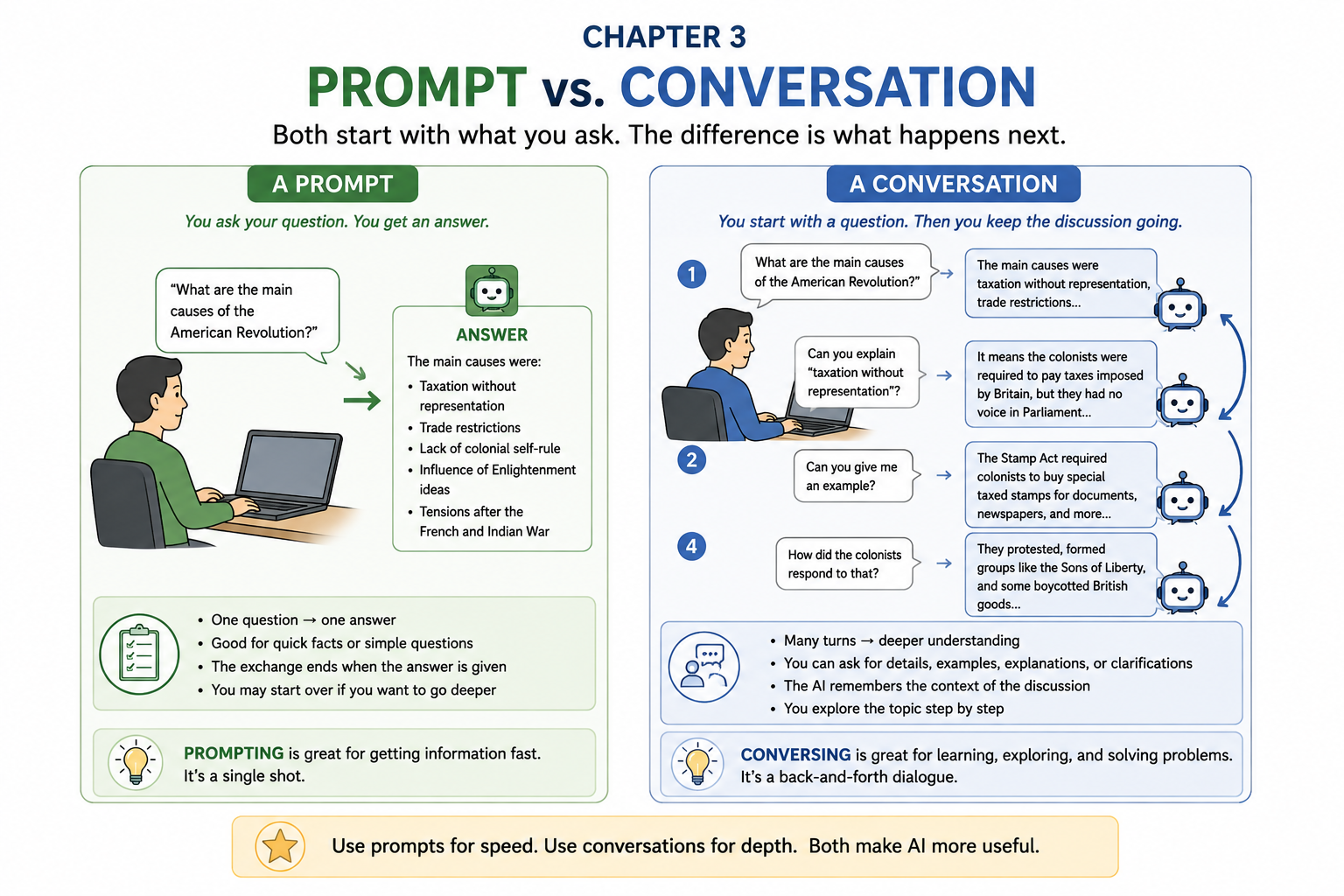
What you'll take away:
Search and conversation are different ways of working with information
Search helps you find information to examine. Conversation can help you work with information and apply it to your situation.
Your first question doesn't have to be perfect
Follow-up questions can add context, correct misunderstandings, and change the direction of the conversation.
Context changes the answer
The more relevant information you provide, the better the AI can respond to what you actually need.
The first answer isn't the destination
An AI response gives you something to react to. Your next question can make the conversation more useful.
Try it yourself
Turn a search into a conversation
Take a question you would normally put into a search engine.
Ask an AI assistant the question in a single sentence. Read the answer.
Then ask three follow-up questions. Try one of these:
Ask for an example.
Give the AI additional context.
Tell it what part of the answer doesn't work for you.
Ask for another perspective.
Ask what important question you haven't asked.
Then ask yourself:
Was the fourth response more useful to me than the first?