

PART IV — Looking Ahead
Book 23
Knowing When AI Isn't Enough
AI Can Help You Prepare
AI can be remarkably useful when you need to understand a subject before talking with someone who has specialized knowledge.
It can help you learn unfamiliar terminology, organize what you have observed, prepare questions, compare options, and explain complicated information in language that makes sense to you.
But preparation isn't the same as professional judgment.
A healthcare professional can examine you and consider your history. A lawyer can apply professional knowledge to the particular facts of your situation. A technician can examine a physical problem. A teacher can see whether a student actually understands something.
AI can help you prepare for those conversations. It doesn't make the conversations unnecessary.
The Physical World Has the Final Say
Some problems can't be fully understood from information on a screen.
A photograph can show a great deal. A description can provide useful details. But there are situations where someone needs to touch an object, hear a sound, observe a person, inspect a system, or simply be present.
The same principle applies to relationships.
A friend who is grieving may need your presence more than a perfectly worded response. A child who is frightened needs a person who is there. Someone who needs to be heard may need a conversation rather than an AI-generated answer.
AI can help us think about what to say.
It cannot take our place in the relationship.
When an Expert Needs to Take Over
I've come to think of AI as a very capable assistant rather than an authority.
It can gather information, identify possibilities, prepare a draft, and suggest questions.
But there is a useful test:
What happens if the AI is wrong?
If the answer is, "I try again," the risk is small.
If the answer is, "I could lose money, damage an important relationship, make a serious mistake, or put my health at risk," the standard needs to be much higher.
That doesn't mean AI has no role in important situations.
It means the AI answer should be one part of a larger process.
A Real Example: My Heat Pump
I had a good example with the heat pump in my sunroom.
On extremely hot days, it wasn't providing the cooling I expected. I could have asked AI what was wrong.
Instead, I used AI to help me find reputable technicians and prepare questions for the person who would examine the system.
The technician eventually found that the situation was more complicated than a simple equipment failure. The size of the sunroom, its windows, and the extreme outdoor temperature were placing demands on the system that mattered to the diagnosis.
AI helped me become a better-prepared homeowner.
The technician had to be there to understand the physical situation.
That distinction applies far beyond heat pumps.
AI can help us become better-prepared customers, patients, students, homeowners, and decision-makers.
Preparation is not the same thing as professional judgment.
The Difference Between an Answer and an Answer That Is Enough
One of the most useful habits we can develop is knowing when to stop asking AI and start asking someone else.
That isn't a failure of AI.
It is a sign that we understand what the situation requires.
Sometimes the next step is a phone call.
Sometimes it is an appointment.
Sometimes it is checking the original document.
Sometimes it is verifying the source.
Sometimes it is sitting across the table from another person.
And sometimes it is simply deciding for ourselves.
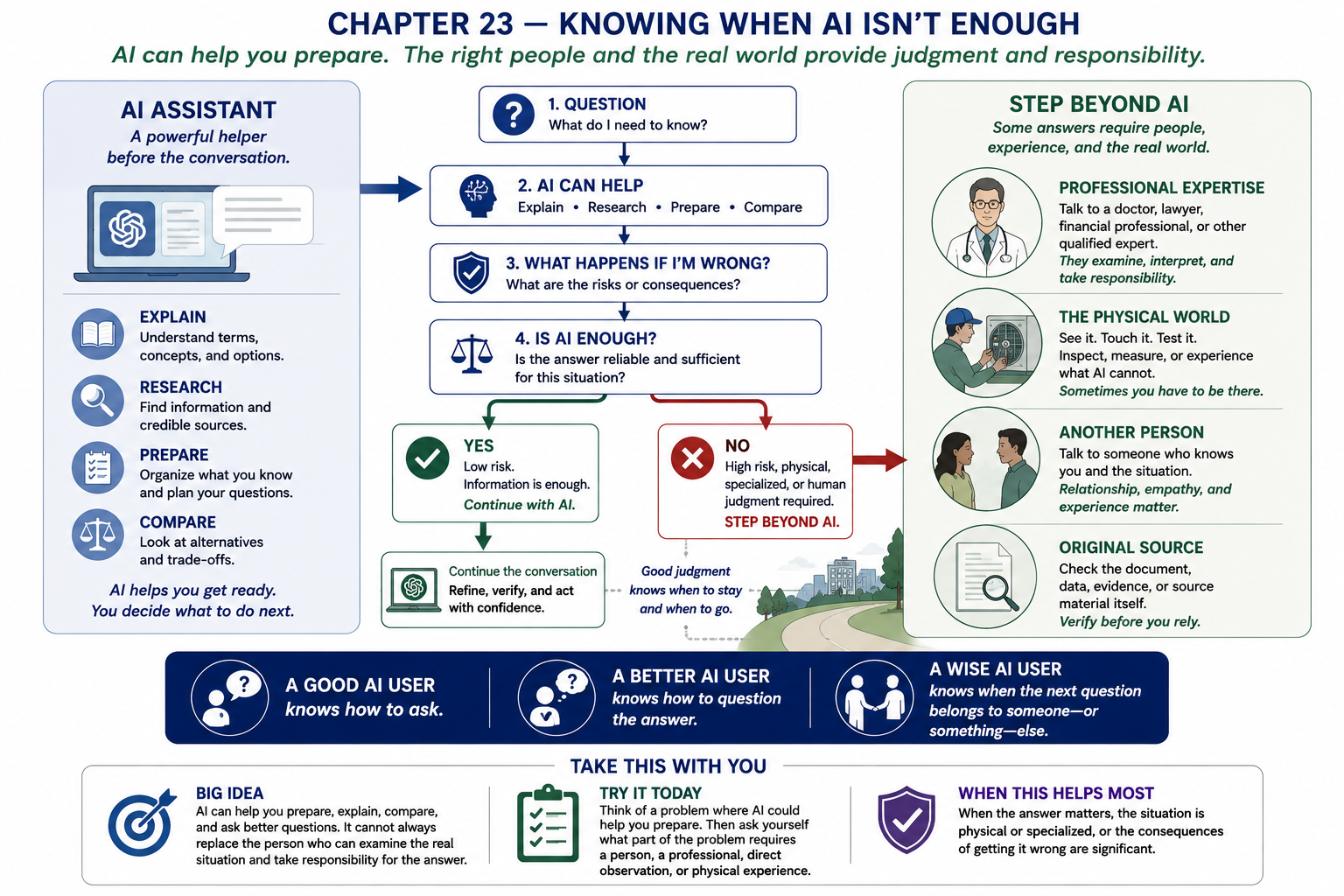
Take This With You
Big Idea
AI can help you prepare, explain, compare, and ask better questions. It cannot always replace the person who can examine the real situation and take responsibility for the answer.
Try It Today
Think of a problem where AI could help you prepare.
Then ask yourself:
What can AI help me understand?
What needs to be verified?
What requires direct observation?
What requires a professional?
What decision remains mine?