

PART IV — Looking Ahead
Book 22
What Will You Do With It?
From What AI Can Do to What We Can Do
When I began using ChatGPT, I was curious about what AI could answer.
Over time, my question changed.
I became less interested in simply finding out what AI could do and more interested in what I could do with it.
That shift leads to a larger question:
Once AI can do more and more things, what will we choose to do with those possibilities?
AI Creates Possibilities; We Supply the Purpose
AI can explain something I don't understand, help me research a subject, compare alternatives, draft an email, revise a chapter, create an image, write HTML, organize information, and help turn an idea into something I can actually use.
The list will keep growing.
But a list of capabilities isn't a plan for a life.
Someone still has to decide what is worth pursuing.
I have seen that distinction repeatedly in my own work with AI. The technology can provide possibilities. I provide the reason for pursuing one of them.
If AI can produce the first draft, comparison, image, code, or plan, we have more room to decide what we actually want to make, learn, solve, or experience.
The Fishing Pond: AI as a Creative Collaborator
The Fishing Pond game I created for my granddaughter is one example.
Claude could write the HTML and revise it when I asked for changes.
The interesting part wasn't simply that AI could produce the code.
It was that a conversation with AI let me turn a small idea into something she could actually play.
The technology supplied capabilities I didn't have to build from scratch.
I supplied the reason for building the game in the first place.
The Book Itself as an AI Project
This book is an even larger example.
I started with an interest in understanding AI and gradually found myself asking whether I could turn what I was learning into something useful for other people.
AI has helped with research, drafting, revision, organization, and many of the mechanical tasks involved in getting a manuscript into shape.
That has changed what is possible for me as a writer.
I can explore an idea, see a rough version, react to it, revise it, and keep going without having to solve every mechanical problem before I can see where the idea might lead.
But the project is still mine.
I decide what the book is about, which experiences belong, what I believe, what I want to question, and what I want the reader to carry away.
Curiosity Is Part of the Point
Curiosity has been part of my relationship with technology for as long as I can remember.
A six-transistor radio was an amazing thing to me.
My Apple IIc opened another door.
Then came increasingly capable personal computers and, later, the cell phone.
The 1964 World's Fair and the Bell Telephone exhibit at Disneyland gave me early glimpses of technologies that seemed to belong to the future. The Dick Tracy wristwatch was becoming reality.
Each experience produced the same basic reaction:
What might be possible?
That question is still with me.
Today I find myself asking it about AI.
Where will it go?
What will it be able to do?
What will it change?
And perhaps the most interesting question of all:
What will people choose to do when capabilities that once seemed difficult become easy?
I don't know the answers.
That is part of what makes it interesting.
Possibility Needs Judgment
AI can give us answers faster than we can evaluate them. It can produce several possibilities before we have had time to think through the first one. It can make a recommendation sound convincing even when the underlying information needs checking.
The habits developed throughout this book still matter:
Ask another question.
Ask what evidence supports the answer.
Ask what might be missing.
Ask another assistant when the issue is important or uncertain.
Check the source.
The point isn't to slow AI down.
It is to keep our own judgment in the process.
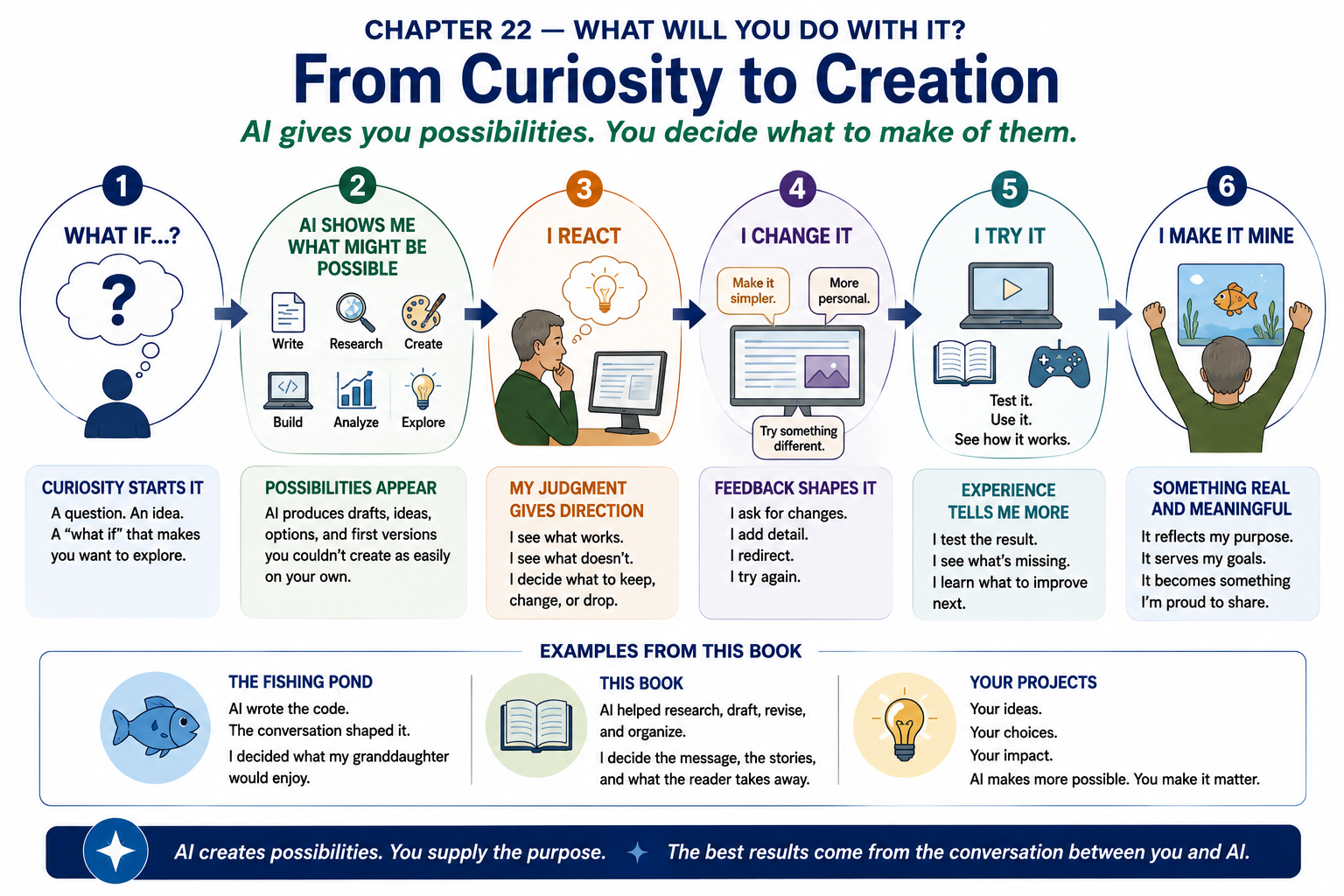
Creative Work Is a Conversation
One of the things I have learned from working with AI is that I don't always know exactly what I want until I see something.
A first version gives me something to react to.
I can say:
"That's too formal."
"Make it more personal."
"Move this."
"Try something completely different."
The AI gives me possibilities.
My reactions give those possibilities direction.
That is collaboration.
The Goal Is Not the Perfect Prompt
I don't think the goal is to write the perfect prompt.
A good prompt can get a conversation started.
What matters after that is what we do with the response.
You know when a paragraph doesn't sound like you.
You know when an image doesn't communicate what you intended.
You know when a game isn't fun.
You know when an explanation doesn't quite connect.
AI can give you something to work with.
You decide what is worth keeping.
Keep Meaning in the Process
There is another possibility I want to protect: using AI to make more things possible without letting it make fewer things meaningful.
If AI writes every email, makes every outline, answers every question, and recommends every decision, convenience can quietly become dependence.
I want AI to make my thinking more productive, not make thinking unnecessary.
That distinction matters when we decide what we want to keep doing ourselves.
What Will You Do With the Time?
I want to keep the parts of life that cannot be delegated.
AI can write a convincing story about a grandparent and a granddaughter.
It cannot have my relationship with my granddaughter.
It can write about a career.
It cannot know what my career meant to me.
It can write about family.
It cannot know the particular people who make that family mine.
Those experiences are part of what makes a life worth living and a story worth telling.
AI can help me tell those stories. It cannot live them for me.
And then there is time.
If AI saves me an hour, what will I do with that hour?
Maybe it goes to family.
Maybe music, learning, volunteering, travel, a hobby, or a project that has been waiting for years.
Maybe it goes to sitting outside with a cup of coffee and doing absolutely nothing productive.
That last possibility is worth protecting, too.
Efficiency and Effectiveness
This is where the distinction between efficiency and effectiveness becomes more than an idea.
Efficiency asks:
How quickly can we get something done?
Effectiveness asks:
Are we spending our time on something that matters?
AI may give us more efficiency.
What we do with that gain determines whether it makes our lives better.
A faster workday isn't necessarily a better life.
The real opportunity may be using some of the time AI gives back for the people, interests, and experiences we value.
The Choice Is Yours
The possibilities created by AI won't be the same for everyone.
One person may use it to start a business.
Another may use it to learn a language.
Someone else may use it to write family history, restore old photographs, create music, plan a trip, learn a new skill, or finally tackle a project that has been sitting on a list for years.
The value isn't in choosing the most impressive use.
It is in choosing a use that matters to you.
The question isn't simply what AI can do.
It is:
What do you want to do that AI can now help make possible?
Use AI Deliberately
You may use AI mostly for work.
You may use it to learn.
You may use it to create.
You may use it to help with a family project.
You may use it to explore a subject you have always wondered about.
You may use it occasionally and prefer to do most things yourself.
There is no single correct way to use the possibilities AI creates.
Start with what matters to you.
Then ask whether AI can help.
Keep your judgment in the process.
Check what needs checking.
Protect information that should remain private.
And when AI gives you time back, decide where you want that time to go.
Leave the Question Open
AI is remarkable.
It is useful.
It will become more capable.
But its value isn't measured simply by what the technology can do.
Its value is measured by what we choose to do with what it makes possible.
That brings me back to the question that has followed me from the World's Fair to the present:
What might be possible?
I have spent a lifetime watching answers arrive.
Now AI is opening another set of possibilities.
I don't know where they will lead.
But I am curious to find out.
Perhaps that is where this chapter should leave the question open.
AI will continue to create possibilities we cannot yet see.
We don't have to predict all of them.
We get to decide which ones are worth pursuing.
What will you do with it?
Take This With You
Big Idea
AI creates possibilities.
You decide which possibilities are worth pursuing and what you want them to mean.
Try It Today
Think of one thing you would like to do, learn, create, or change.
Ask AI:
"What could you help me make possible?"
Then decide whether the possibility is worth pursuing.