

PART IV — Looking Ahead
Book 21
Living With AI
How Much Responsibility Should AI Have?
As AI becomes an ordinary part of daily life, a different question becomes more important:
How much responsibility should we give it?
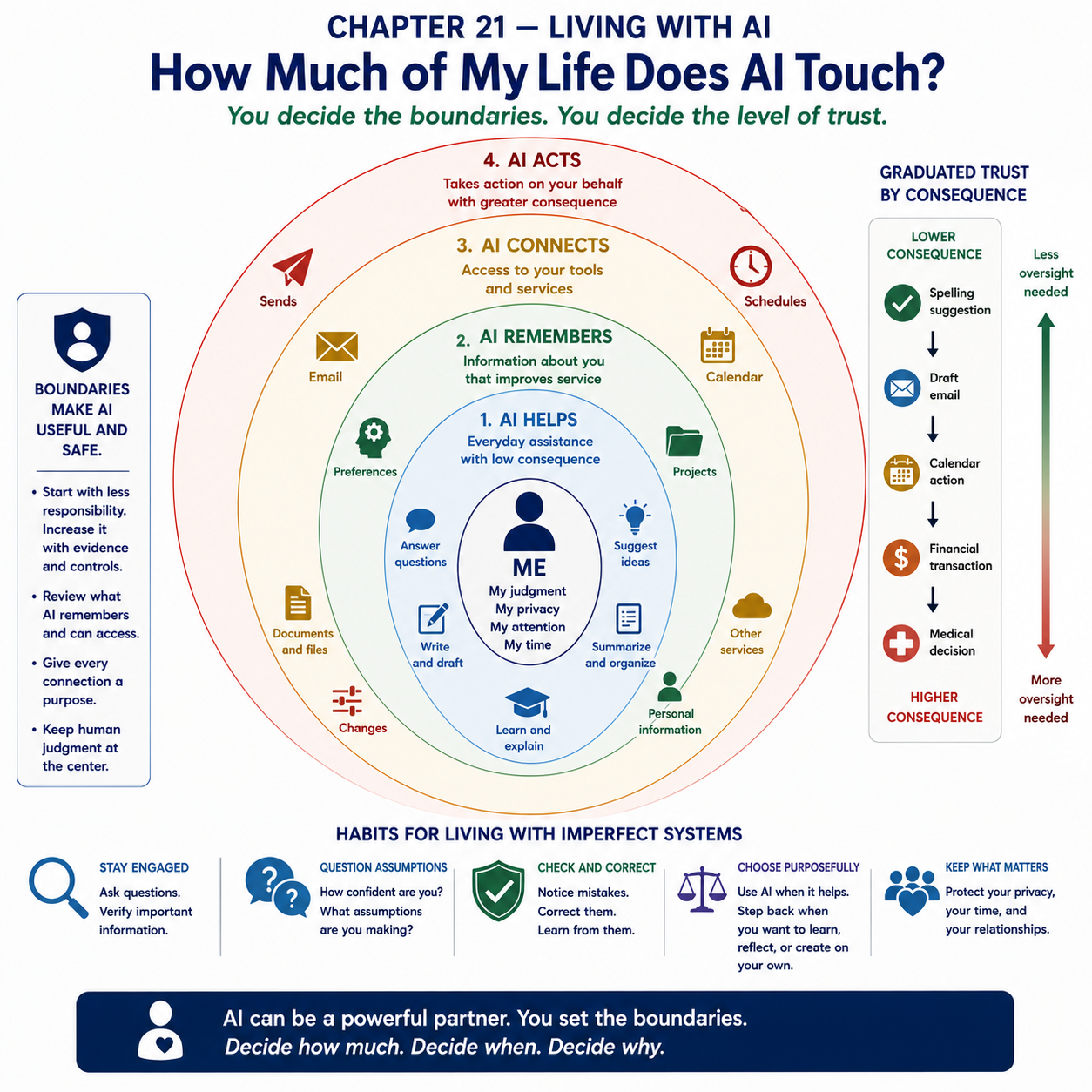
There is a big difference between asking AI to suggest three ways to organize a project and giving it permission to organize the project itself.
There is a difference between asking for an email draft and allowing AI to send the message.
There is a difference between asking for information about a purchase and allowing an AI system to spend money.
These are different levels of trust.
A spelling suggestion might happen automatically. An email draft may deserve a quick review. A financial transaction may require explicit approval.
The technology may be capable of doing all three.
Our level of trust should not be the same for all three.
Memory and Personal Information
AI can become more useful when it knows more about us.
An assistant that remembers how we prefer information presented, what projects we are working on, or what we have already discussed can save time and reduce repetition.
But that raises personal questions:
What should AI remember?
How long should it remember it?
Who can access that information?
How easily can we correct or remove it?
Some information may be useful for an assistant to remember.
Other information may be better kept outside the system.
The choice is personal.
What matters is making the choice deliberately rather than letting convenience make it for us.
Connected Services
An AI assistant connected to a calendar can help schedule things.
One connected to email can help sort messages.
One connected to documents can help find information.
An assistant connected to all three can do much more.
Each connection can be useful. Each connection can increase what the system knows and what it can do.
That makes permissions part of everyday AI literacy.
Before connecting a service, ask:
What can AI see?
What can it change?
What can it do without asking me first?
Living With Imperfect Systems
No matter how capable AI becomes, mistakes will remain.
An AI system may misunderstand a request, use an outdated source, interpret an image incorrectly, or make a reasonable decision based on an incorrect assumption.
The goal isn't to find a system that never makes mistakes.
The goal is to build habits that let us notice, correct, and contain those mistakes.
Questions such as these can help:
"How confident are you?"
"What assumptions are you making?"
"What should I verify?"
"What could make this answer wrong?"
The more consequential the decision, the more independent checking matters.
When to Use AI—and When Not To
Living with AI also means deciding when to leave it alone.
There will be times when I want an answer immediately.
There will be other times when I want to work through a problem myself.
Sometimes I want help writing.
Sometimes I want to write without assistance.
Sometimes I want an explanation.
Sometimes I want to sit with a book and work something out slowly.
Having access to AI doesn't mean giving up the pleasure of doing things ourselves.
For me, that is part of the fun.
AI should add possibilities to life, not remove the things we enjoy doing ourselves.
Choosing the Right AI
I don't need one AI assistant to do every job.
I need a tool that fits the job I'm trying to accomplish.
One assistant may fit naturally with the services I already use. Another may be better suited to a particular kind of research, writing, coding, image work, or document analysis.
So the useful question isn't:
"Which AI is the best?"
It is:
"Which tool fits what I'm trying to do?"
That question is much less likely to become outdated.
Making AI Part of a Routine
Recurring AI tasks can be useful when they fit naturally into something we already do.
A morning report.
A research routine.
A writing template.
A project assistant.
A scheduled update.
But a routine should serve our lives rather than quietly taking over our attention.
Ask yourself:
Is this helping me do something I value, or am I maintaining the routine simply because I created it?
If an AI routine saves time and improves the result, keep it.
If it creates more work than it removes, change it or let it go.
What Will You Do With the Time?
This may be the most personal question of all.
This may be the most personal question of all.
If AI saves us an hour, the hour belongs to us.
We can use it for more work.
We can answer more messages.
We can take on another project.
Or we can use it for something that has nothing to do with productivity.
Family.
Music.
Learning.
A hobby.
Volunteering.
A walk.
Time to sit quietly.
AI may create the possibility.
It doesn't tell us what to do with it.
That is where efficiency and effectiveness meet.
AI may give us more time. Effectiveness asks what we choose to do with that time.
A more efficient workday is useful.
A better workday that leaves room for the rest of life may be much more valuable.
Keeping AI in Its Place
AI may eventually feel as ordinary as a computer or cell phone.
We may ask questions, dictate messages, show photographs, summarize documents, plan projects, and solve problems without thinking much about which AI system is doing the work.
That convenience can be welcome.
But ordinary should not mean automatic.
We should still know:
when AI is involved
what it is doing
what information we have given it
what it is allowed to do
when we should take over
The goal isn't to keep AI at a distance.
It is to make room for AI without giving away more of our judgment, privacy, attention, or time than we intend.
Take This With You
Big Idea
Living with AI means deciding how much of your life you want AI to touch, how much responsibility you want to give it, and what you want to do with the time it gives back.
Try It Today
Choose one area of your life where AI could be useful.
Decide:
what you are comfortable letting AI do
what you want to review yourself
what you do not want AI involved in
Then try that boundary for a week.