

PART IV — Looking Ahead
Book 20
The Human Advantage
Purpose Comes From Us
As AI becomes better at writing, searching, analyzing, creating, and carrying out tasks, a natural question emerges:
What remains especially valuable about being human?
For me, the answer begins with purpose.
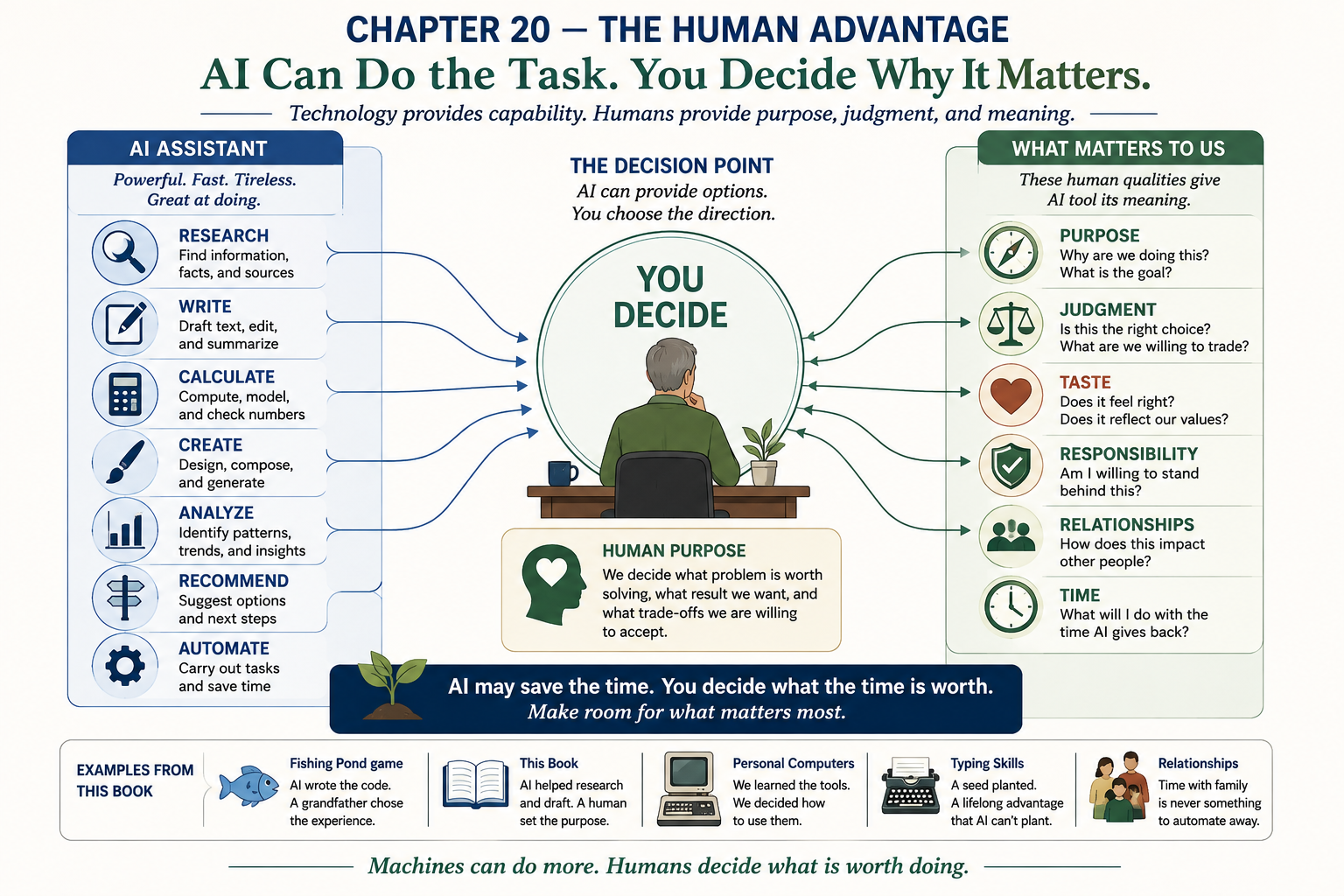
AI can help carry out an assignment. It can generate possibilities, analyze information, and produce results. But the reason for doing the work comes from us.
We decide what problem is worth solving.
We decide what result we want.
We decide what matters.
That distinction becomes more important as AI becomes more capable.
AI Can Do More. That Doesn't Mean It Should Decide More.
Think about a project such as creating a game.
AI can write the code. It can change the design, add features, fix problems, and produce another version.
But it cannot decide whether the finished game is right for the person who will play it.
That requires purpose, judgment, and knowledge of the audience.
The same applies to this book. AI can help with research, drafting, revision, organization, and many other parts of the work.
But AI didn't decide why I wanted to write the book.
It didn't supply the experiences that led me here.
It didn't decide which stories belonged or what I wanted readers to take away.
AI can contribute to the work without owning the purpose of the work.
Curiosity Keeps Us Looking Ahead
Curiosity is another human advantage.
I've lived through several generations of technology that once seemed extraordinary: a small transistor radio, my Apple IIc, increasingly capable personal computers, the cell phone, and now AI.
Each one made me wonder:
What might be possible next?
AI makes that curiosity especially easy to exercise. You can ask a question, follow the answer, ask another question, and explore an idea you hadn't expected to encounter.
That is one reason I don't think becoming an effective AI user means learning every feature.
It means staying curious enough to ask:
What else might be possible?
Judgment Still Matters
AI can produce several answers in seconds.
That changes the problem.
Finding an answer may become easier. Deciding which answer deserves attention may become harder.
Is it accurate?
Is it relevant?
What evidence supports it?
What assumptions does it contain?
What might be missing?
The habits developed throughout this book—asking better questions, checking sources, comparing answers, and questioning assumptions—remain useful as AI improves.
More information increases the value of good judgment.
Taste Is Still a Human Choice
AI can generate possibilities almost endlessly.
That makes selection important.
A writer chooses the sentence.
A photographer chooses the image.
A musician chooses the interpretation.
A teacher chooses the example.
A designer decides what to leave out.
AI can help produce possibilities, but you still have to recognize what feels right for your purpose.
That is one reason I've become less interested in the idea of the perfect prompt.
A prompt can start the process.
Taste helps decide where the process goes.
Relationships Have Meaning
AI can help prepare us for human conversations.
It can organize our thoughts, help us anticipate objections, or show us another point of view.
But the conversation still has to happen.
The apology still has to be made.
The celebration still has to be shared.
The time with another person still matters.
If AI eventually makes routine communication almost effortless, a genuinely personal message may become more meaningful precisely because someone took the time to write it.
The scarce resource may not be information.
It may be attention.
Responsibility Cannot Be Delegated
AI may eventually be able to take much more direct action.
That makes responsibility even more important.
If AI makes a recommendation, someone still has to decide whether to act on it.
If AI prepares a financial comparison, someone still has to make the decision.
If AI writes a business proposal, someone still has to stand behind it.
The more capable AI becomes, the easier it may be to confuse capability with authority.
They are not the same thing.
A human in the loop should mean more than checking a box after AI has made the important decisions.
We should remain involved in deciding:
what the system is trying to accomplish
what information matters
what risks are acceptable
whether the result makes sense
what happens next
What Will We Do With the Time AI Gives Back?
There is another human question hiding inside AI's increasing efficiency.
What will we do with the time it gives back?
We could fill that time with more work.
More email.
More meetings.
More obligations.
Or we could decide that some of the time belongs to us.
Family.
Music.
Learning.
Volunteering.
Travel.
Hobbies.
Projects that have been waiting for attention.
Or simply time with no productive purpose at all.
That connects with the distinction between efficiency and effectiveness.
Efficiency asks how we can do something faster.
Effectiveness asks whether we are doing something that matters.
AI may give us more efficiency.
What we do with that gain determines whether it makes our lives better.
The Human Skills That Endure
We don't have to know exactly what AI will look like five years from now.
We can work on abilities that remain useful across changes in technology:
Curiosity.
Judgment.
Taste.
Purpose.
Responsibility.
Relationships.
The ability to decide what matters.
These abilities don't compete with AI.
They give AI a reason to be useful.
Take This With You
Big Idea
As AI becomes more capable, human purpose, curiosity, judgment, taste, responsibility, relationships, and the ability to decide what matters become more important—not less.
Try It Today
Think about one task AI could realistically handle for you.
Then ask a second question:
If AI handled that task, what would you want to do with the time it gave back?