

PART I — Learning How to Work With AI
Book 2
What Are We Actually Talking To?
Where is the AI? Is it in your phone? In a speaker? On the Internet? In the cloud? A simple question from a child leads to a useful way of thinking about what we are actually talking to when we use AI.
You don't need to understand all the technology before you can use it.
So Where Is the AI?
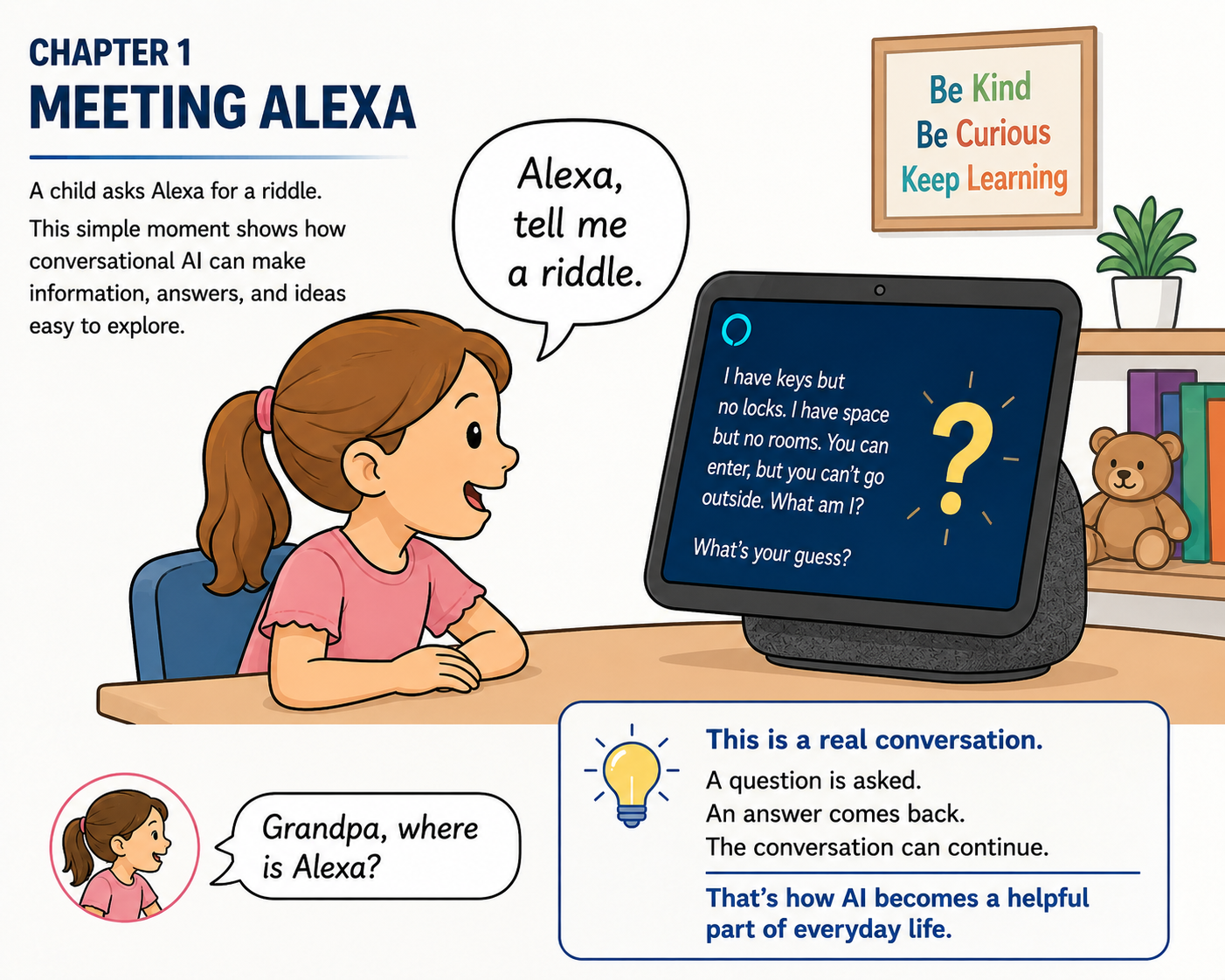
Not long ago, our granddaughter Callie was talking with Alexa. She was asking questions, listening to answers, and carrying on a conversation. Then she asked, "Where is Alexa?"
She wasn't asking where the speaker was. She was asking about the one she had been talking with.
That question provides a useful starting point for understanding AI.
The device you use is the interface. The AI service, model, and computing infrastructure work together behind that interface. Much of the processing for large AI systems happens in data centers, although some AI processing can happen directly on your device.
The goal isn't to learn all the machinery. It is to develop a mental model that remains useful as the technology changes.
The name on the screen doesn't tell you everything.
When you use ChatGPT, Claude, Gemini, or another AI assistant, the name you see identifies the service you are using. That service may use one or more AI models, along with computing, storage, networking, tools, and other systems that make the conversation possible.
The model processes the information available in the interaction and generates a response. It isn't simply retrieving a perfect answer from a giant database.
That helps explain something you'll encounter throughout this book: AI can produce remarkably useful responses, yet it can still be wrong.
It can work with language remarkably well without being an all-knowing person.
The conversation is the interface. The system behind it is not a person, and it is not infallible.
What you'll take away:
AI isn't the device
Your phone, tablet, computer, or smart speaker is the way you communicate with the AI system.
AI isn't one single product
Different assistants may use different models, tools, information, and capabilities.
AI generates responses
For the language-based AI discussed in the book, the model uses patterns learned during training and the information available in the current interaction to generate its response.
Fluent doesn't mean infallible
AI can communicate remarkably well without knowing everything or always being correct.
Try it yourself
Ask an AI assistant:
"Explain what you are in terms that a curious twelve-year-old could understand. Then tell me what your explanation leaves out."
Read the answer. Then ask:
"What part of your first explanation is most likely to give me the wrong impression?"
The second question is the interesting part. It asks the AI to examine its own explanation rather than simply giving you another answer.
AI can work with language remarkably well, but conversational fluency doesn't make it an all-knowing person.