

PART IV — Looking Ahead
Book 19
Where Do We Go From Here?
AI Is Moving From Answers to Actions
When I began using ChatGPT, I thought of AI mainly as something I could ask questions.
That seems almost quaint now.
AI has moved from answering questions toward helping people create, analyze, organize, and act. Today's tools can work with text, images, documents, code, and information from the web. Some can remember context. Some can connect with other services. Some can perform tasks rather than simply explain how a person might perform them.
That raises a more interesting question than which AI system will be most popular next year:
Where is this technology going?
I don't think anyone can answer that with confidence.
The names will change. Capabilities will change. Some tools may disappear, while others we have never heard of will become familiar.
So rather than predict particular products, let's look at several changes that may shape how we interact with AI.
The Next Stage of AI
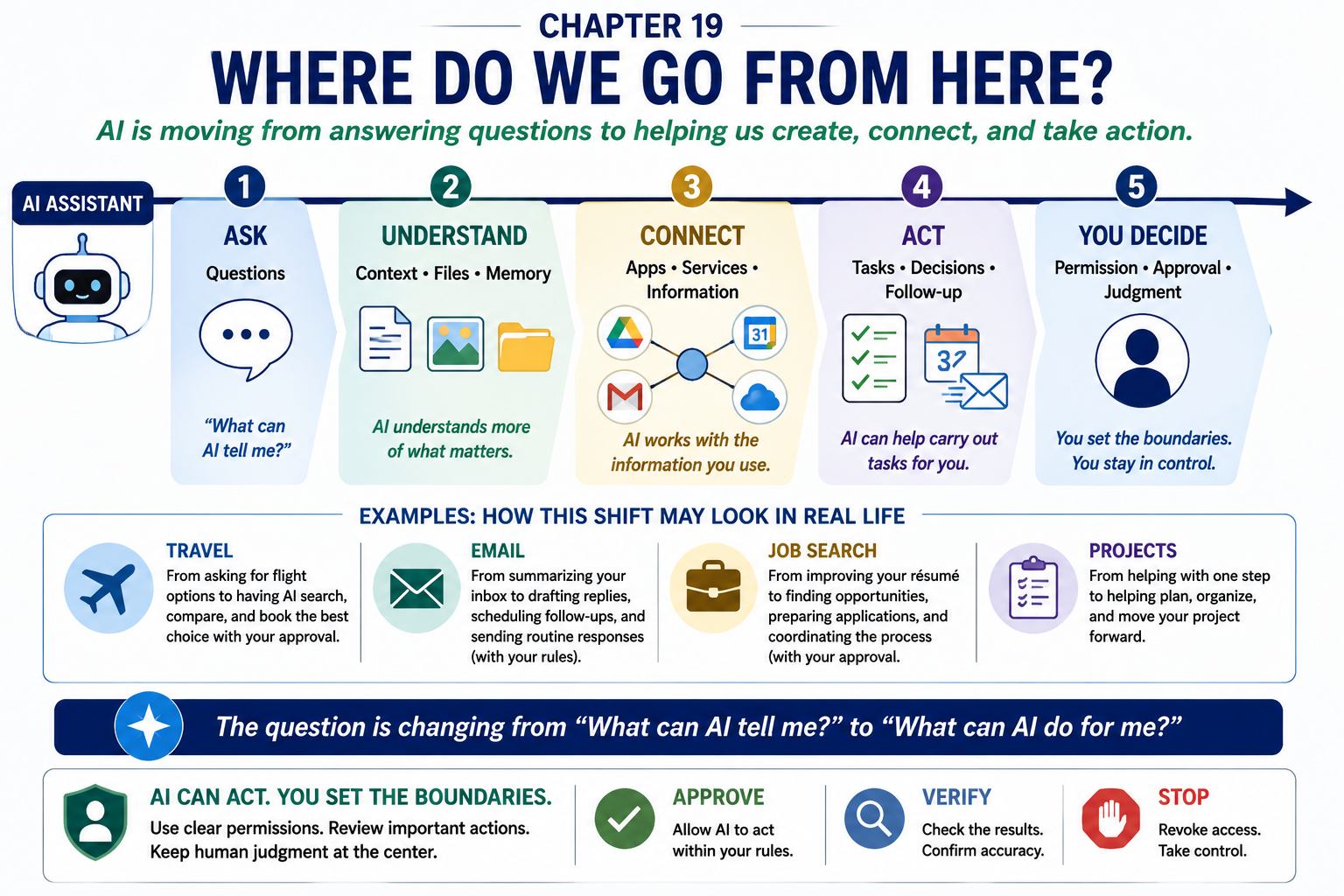
One of the biggest changes may be the movement from AI that answers questions to AI that can carry out tasks.
Today, you might ask an assistant to compare several flights and then make the reservation yourself.
A more capable assistant could search the choices, apply your preferences, identify the best options, ask for your approval, and complete the reservation.
The difference is significant.
The first system gives you information. The second can carry out part of the process.
The same shift can happen with email. AI might summarize your inbox or draft a response. A more capable assistant could identify messages requiring attention, prepare replies, schedule follow-ups, and perhaps send routine responses after you establish the rules.
The question changes from:
“What can AI tell me?”
to:
“What can AI do for me?”
But action requires permission.
If an AI can spend money, change a calendar, send an email, or place an order, someone has to establish the boundaries.
Capability does not automatically mean permission.
AI With More Context
Another likely change is that AI will have access to more of the information surrounding a task.
Instead of explaining a problem in a long prompt, you may be able to show the system the document, photograph, spreadsheet, recording, or screen where the problem appears.
That is already happening.
A photograph of a damaged object may communicate more than a paragraph describing it. A screenshot of an error message may be easier than typing the message accurately. A document can be examined directly rather than summarized first.
The ability to show rather than describe can make AI useful to people who have never thought of themselves as particularly technical.
AI may become better at remembering context, too.
An assistant that remembers how you prefer information presented, what projects you are working on, or what you have already discussed can save time and reduce repetition.
But memory raises personal questions:
What should an AI remember?
How long should it remember it?
Who can access that information?
How easily can you correct or remove it?
Those questions will become part of ordinary AI use as memory becomes more capable.
AI Inside the Software We Already Use
Another change may be less dramatic but just as significant: we may stop thinking about AI as a separate application.
AI is already appearing inside email programs, word processors, browsers, photo tools, presentation software, search services, and other applications.
You may not open an AI program and decide to use AI.
You may simply notice that the software you already use can:
summarize a document
rewrite a paragraph
translate a message
modify a photograph
create a presentation
analyze a spreadsheet
AI may become a layer inside everyday software rather than a destination we visit.
That could make AI almost invisible.
People may use AI every day without thinking of themselves as “AI users.”
That makes basic AI literacy more important, not less.
We should still be able to ask where information came from, how confident a system is, what assumptions it made, what information it used, and what it is actually doing on our behalf.
AI and Work
AI is likely to change work as well.
Some tasks will become faster. Some routine responsibilities may disappear. Other responsibilities may change shape.
A person who once spent hours preparing a report may spend less time assembling information and more time reviewing it.
Someone who wrote routine correspondence may spend more time handling unusual cases that require judgment.
A programmer may spend less time writing routine code and more time deciding what the software should accomplish and testing whether it actually works.
The job may remain.
The work inside the job may change.
We cannot predict exactly which occupations will be affected or how quickly.
Technology rarely changes every part of a field at the same speed. Adoption will vary by organization, cost, trust, training, regulation, and culture.
What seems more certain is that people will need to adapt.
That doesn't necessarily mean becoming an expert programmer or learning every new AI feature.
It may mean becoming comfortable asking better questions, checking results, working with AI-generated material, and deciding when a person needs to take over.
The AI Ecosystem Will Keep Changing
It is tempting to ask which AI assistant will win.
I don't think that is the most useful question.
There may not be one winner.
Different systems may develop different strengths. One may be useful for research. Another may be excellent at coding. Another may work especially well with images or documents. Another may fit naturally into the services a person already uses.
New tools may combine several of these capabilities.
The ecosystem will continue to change.
That means the skill that matters most may not be loyalty to one particular tool.
It may be adaptability.
If the assistant you use today changes its capabilities tomorrow, you should be able to ask the same basic question:
“What am I trying to accomplish, and which available tool can help me do it well?”
That question can survive changes in product names and interfaces.
What We Cannot Yet See
There are developments ahead that are difficult to predict.
AI may become much better at long-running projects. It may coordinate information from several services. It may operate across computers and devices. It may become a more capable partner in research, programming, education, and creative work.
Some possibilities may arrive sooner than expected.
Others may prove much harder than they appear today.
There will probably be surprises.
That uncertainty is part of what makes this period so interesting.
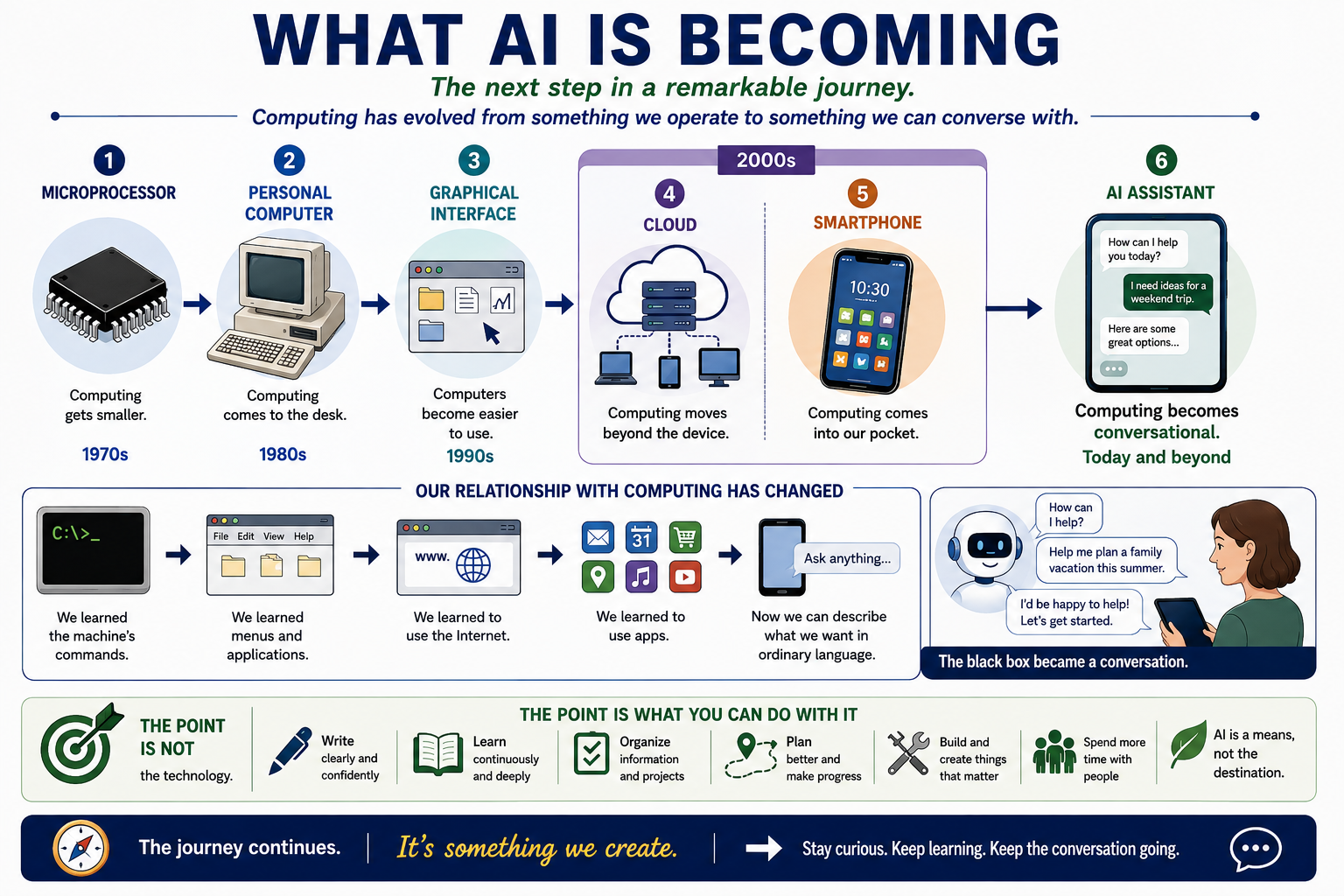
I have lived through several waves of technology that once seemed extraordinary and later became ordinary. A six-transistor radio, my Apple IIc, increasingly capable personal computers, and the cell phone each changed what seemed possible.
AI is another step in that long sequence.
The difference is that AI is beginning to participate in the work of thinking, communicating, creating, and deciding.
That makes its development worth watching closely.
The Questions That Matter
The question for the rest of this book is not whether AI will become more capable.
I think it will.
The more useful questions are:
What should we delegate?
What should we continue to do ourselves?
What should require our approval?
What information should we share?
How should we prepare for technology that may be very different five years from now?
We can begin answering those questions without knowing exactly what the future holds.
Take This With You
Big Idea
AI is moving from answering questions toward working with context, connecting to other tools, and taking actions.
The specific systems will change.
The need to decide what AI should do—and what it should not do—will remain.
Try It Today
Think of one task you currently perform from beginning to end.
Ask yourself:
Which part could safely be handled by AI?
Which part should remain yours?
Which part would require your approval?
That simple exercise gives you a way to think about the future without having to predict it.