

PART III — Becoming an Effective AI User
Book 18
Staying in Control of Your AI Use
AI Should Remain Your Tool
The more useful AI becomes, the easier it is to let it become part of everything we do.
That is where I think we need to pause.
The purpose of this book has never been to persuade you to use AI for every possible task. It has been to help you use AI well.
The better question is not:
“What can AI do?”
It is:
“Where would AI genuinely help me accomplish something I care about?”
That distinction can keep AI in its proper place.
AI can help you write, learn, compare choices, organize information, prepare for conversations, and create things. But some experiences are valuable precisely because they are direct and personal.
You don't need AI to listen to a friend, play music, take a walk, read a book, work in the garden, or spend time with your family.
AI can be useful without becoming necessary for everything.
Keep Your Purpose in Charge
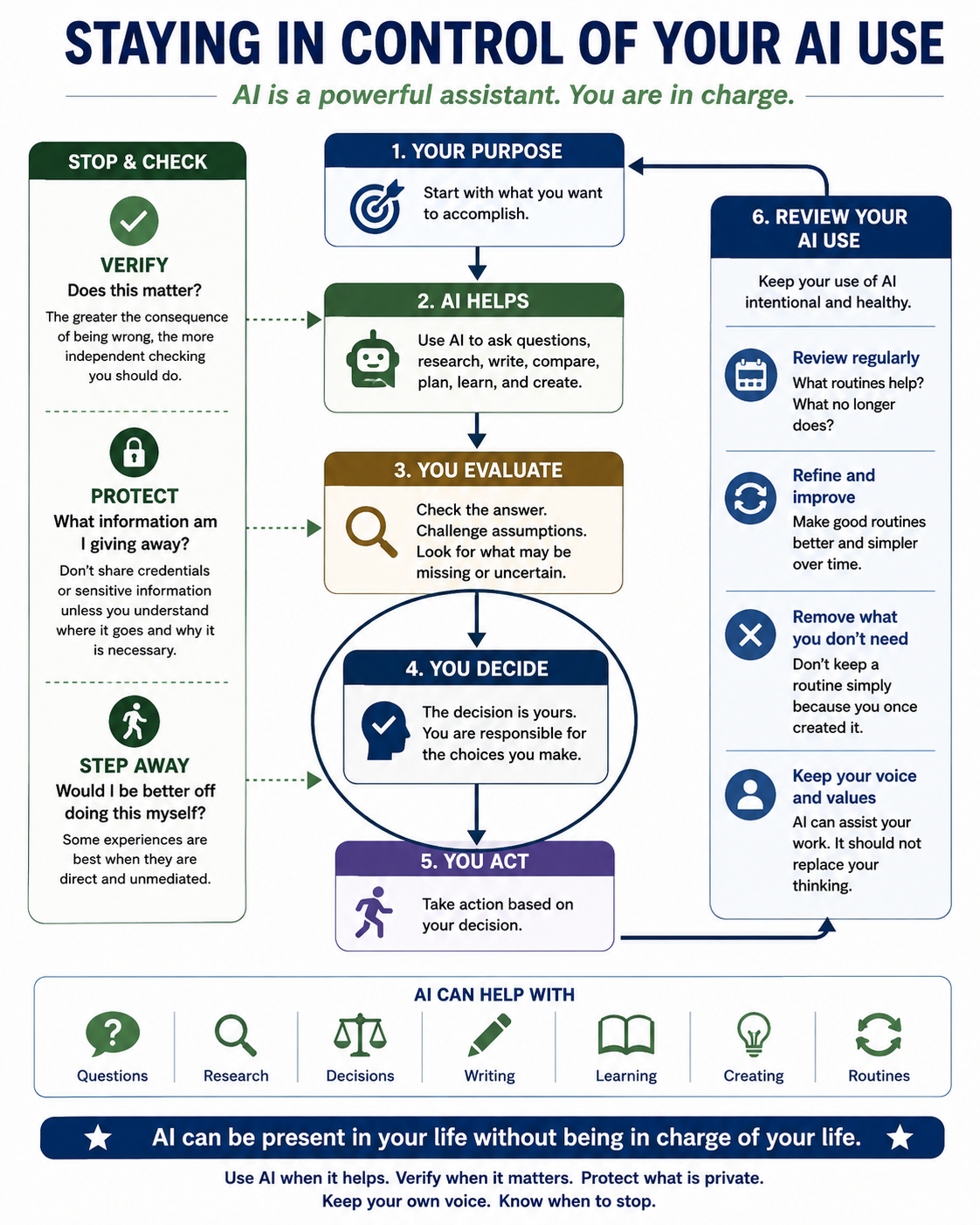
One of the easiest ways to lose control of any technology is to begin with the technology instead of the purpose.
“Let's see what AI can do” can be an interesting experiment.
“Here is something I want to accomplish. Can AI help?” is a better working question.
Start with your goal. Let AI have a supporting role.
AI can help define a problem, offer possibilities, expose assumptions, compare alternatives, and make recommendations.
The purpose still comes from you.
That matters even more when AI is involved in an important decision.
You can ask why an AI made a recommendation. You can challenge its assumptions. You can check the evidence. You can ask another assistant. You can decide not to follow the recommendation.
The fact that an AI sounds confident does not transfer responsibility for the decision to the AI.
The decision is still yours.
Keep Verification in the Process
AI may sound as though it has a complete picture when it doesn't.
It may lack current information. It may misunderstand your question. It may have incomplete sources. It may produce an answer that sounds plausible but is wrong.
One useful habit is to make uncertainty visible.
Ask:
“What are you least certain about?”
“What information are you missing?”
“What would you want me to verify?”
“Which part of your answer is an inference rather than a fact?”
The level of checking should match the consequences of being wrong.
A casual question about a movie does not require the same checking as a question involving a medical issue, legal obligation, financial decision, or important professional document.
The greater the consequence of being wrong, the more independent checking you should do.
Protect Your Information
There is another boundary worth keeping.
Don't give an AI system credentials simply because doing so would make a task easier. Don't paste sensitive information unless you understand where it is going and why you need to provide it.
When you need AI to work with information from another source, there may be safer ways to provide what matters: copy permitted material, download a report you are allowed to use, provide an appropriate screenshot, or summarize the relevant information yourself.
Convenience is not a sufficient reason to give away control of your information.
Stay Involved in the Work
There is another form of losing control that can be harder to notice.
You ask AI to write something.
Then you ask it to rewrite it.
Then you ask it to make the decision.
Then you ask it to explain the decision.
Eventually, you may find that you are accepting outputs without engaging with the underlying problem.
The answer isn't to stop using AI. It is to stay involved.
Ask yourself:
Do I understand the answer?
Could I explain the decision?
What assumptions were made?
Could I recognize an obvious error?
Would I make the same choice if the AI recommendation were removed?
Those questions keep you in the process.
Keep Your Own Voice
AI can produce polished writing very quickly. It can improve structure, remove repetition, and help turn rough ideas into clearer prose.
But polished writing is not automatically authentic writing.
Your voice includes your experiences, humor, memories, preferences, and the way you see the people and events in your life.
That is one reason personal experiences have a place in this book. The story of moving from one AI assistant to another, the Fishing Pond game, and the scheduled sports updates matter partly because they actually happened.
AI can help you express your voice.
It should not quietly replace it.
You Don't Have to Follow Every AI Change
Staying in control does not mean following every AI announcement.
Features change. Pricing changes. Privacy policies change. Capabilities change. A task that once required a complicated workaround may become simple. A feature you relied on may disappear.
You do need to notice changes that affect the way you use AI.
A small periodic review can be enough:
What am I using AI for now?
Is it still helping?
Has anything changed?
Is there a better way to do this?
Is there anything I should stop doing?
Those questions can keep your AI use intentional.
One AI Does Not Have to Do Everything
There is no rule saying that one AI assistant has to do everything.
You may prefer one for everyday conversation, another for research, another for coding, and another for scheduled information.
My own experience led me there naturally. I didn't set out to build a collection of AI assistants. I found different uses for different tools.
The important question is not how many assistants you use.
It is whether you know why you are using each one.
Sometimes You Should Stop Asking AI
There is one final boundary that may be the most important.
Sometimes you should simply stop asking AI questions.
Make the phone call.
Have the conversation.
Read the original book.
Look at the photograph.
Play the piano.
Work in the garden.
Spend time with your family.
Sit quietly and think.
Those activities may produce no AI output at all.
That's fine.
The time AI gives us is valuable partly because we can choose what to do with it. We can use it to do more work, learn, or create.
Or we can use some of that time to live without a screen.
Make Your Own Rules
Perhaps the most useful thing to do at the end of Part III is to create a few personal rules for AI use.
Mine might be simple:
I will use AI when it genuinely helps.
I will check important information.
I will protect private information.
I will question recommendations that matter.
I will keep my own judgment and my own voice.
I will save useful AI routines without making everything a workflow.
I will use the right tool for the job.
I will remember that some of the best uses of the time AI gives me back have nothing to do with AI.
Your rules may be different.
The point is to have them.
Take This With You
Big Idea
The goal of becoming an effective AI user is not maximum AI use.
It is purposeful AI use while keeping your judgment, privacy, priorities, relationships, and time under your control.
Try It Today
Write down:
Three things you want AI to help you do.
Three things you don't want AI to take over.
Keep the list somewhere you can revisit it.