

PART III — Becoming an Effective AI User
Book 17
Working With AI Every Day
AI Becomes Useful When It Fits Your Life
By now, AI may have stopped feeling like something you occasionally try and started feeling like something you can actually use.
The real value is unlikely to come from one spectacular conversation. It comes from the small ways AI can become useful in ordinary life:
preparing for a meeting;
explaining something you don't understand;
organizing information;
drafting a message;
planning a project;
comparing choices;
learning something new.
The question I find most useful isn't:
"What can AI do?"
It is:
"Where would AI make this particular task easier, clearer, or more useful?"
That keeps the technology in its proper place.
AI is a tool. Its value depends on how well it serves the task.
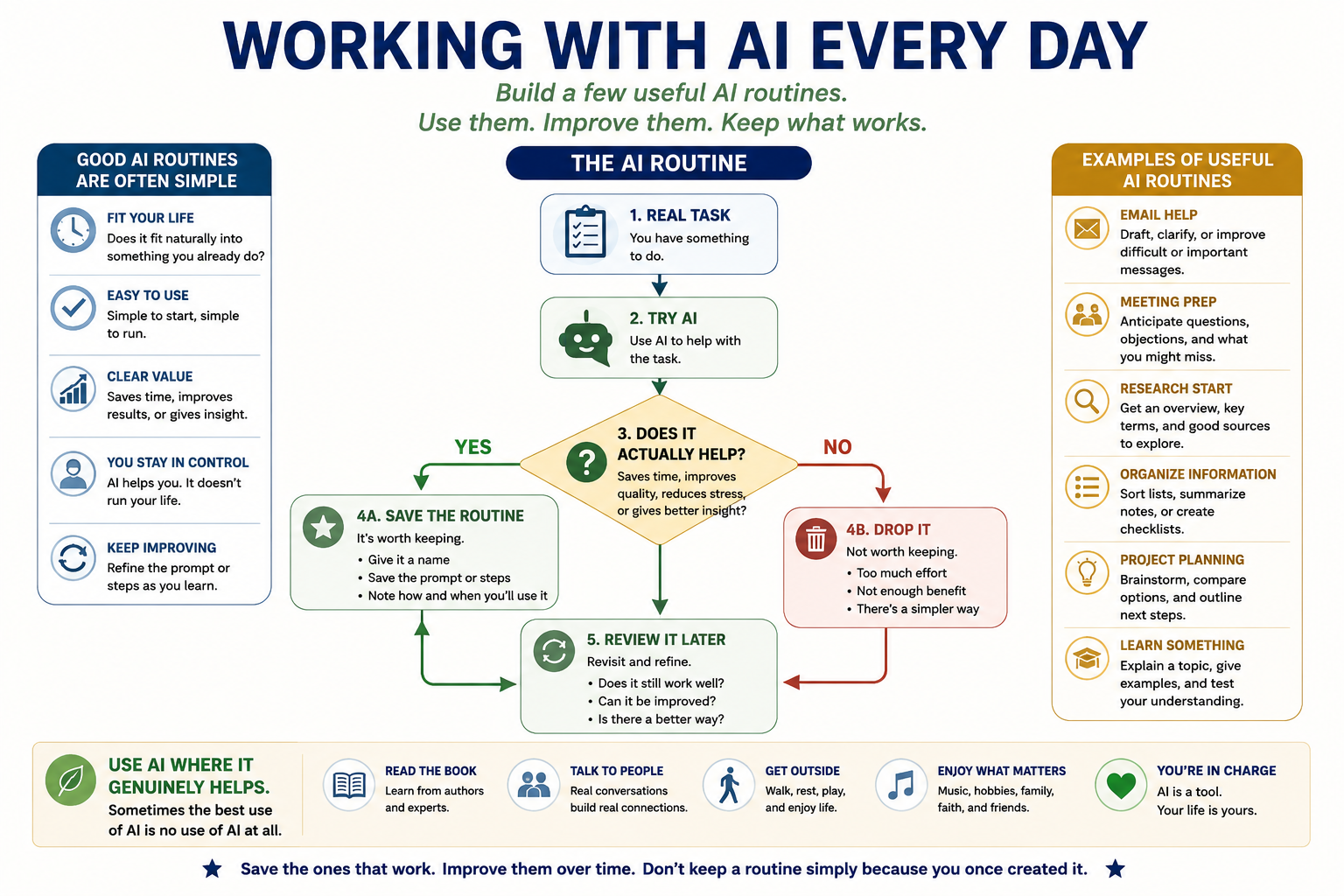
Start With the Task, Not the Technology
Think about a normal day.
You check the news.
You have an email to write.
You see something online you don't understand.
You need to organize a list.
You want to learn something.
You have an appointment and want to prepare.
You are working on a personal project.
None of these requires AI.
Several might benefit from it.
That distinction matters.
If we start looking for a reason to use AI in every situation, we can create work instead of reducing it.
Sometimes the best use of AI is no use of AI at all.
A Recurring Routine Can Be More Useful Than a One-Time Answer
One of my examples is the scheduled sports update I created with Grok.
I wanted current information about my favorite teams, but I didn't want to search several sites every morning and sort through everything myself.
A scheduled update gave me a useful starting point for the day.
The value wasn't simply receiving information.
It was receiving the information in a form that fit a routine I already had.
That suggests a useful test:
Does this AI task fit naturally into something I already do?
If yes, it may save time.
If you have to remember a complicated prompt, interpret a long response, correct it, and perform several more steps, you may not have saved much time at all.
The best AI routines are often surprisingly simple.
Use AI Where the Task Benefits
Email is an obvious example.
You don't need AI to write every message. Sometimes a two-sentence email is faster to write yourself.
A difficult message is different.
You may need to explain a problem without sounding angry. You may need to decline a request politely. You may know what you want to say but can't find the right words.
Give AI the substance and ask it to help with the presentation.
For example:
"Here is what I need to say. Keep the message friendly, but make the request clear. Don't make it sound more formal than necessary."
Then react to the draft.
"That's close. Make it sound more like something I would actually write."
You know what you mean.
AI helps you express it.
AI Can Help You Prepare
AI can be useful before a difficult conversation or meeting.
Instead of asking AI to tell you what to say, ask it to help you prepare.
Try:
"What questions am I likely to be asked?"
"What objections might come up?"
"What am I failing to explain?"
"Give me the strongest argument from the other person's point of view."
"What should I make sure I don't forget?"
This turns AI into a rehearsal partner.
The same approach works for presentations.
Give AI your outline and ask it to act as a skeptical audience member.
Then answer its questions yourself.
You may discover that the weak part of the presentation isn't the slide design.
It may be the argument.
AI Can Be a First Stop for Learning
AI can be useful when you want to learn about a subject.
Ask for an overview.
Ask for the important terms.
Ask which sources are worth reading.
Ask what questions you should investigate next.
Then check important claims against reliable sources.
The goal isn't to let AI replace research.
The goal is to use AI to find a productive path through the research.
A search engine may give you hundreds of pages.
AI can help you figure out what you are actually looking for.
Then you can go to the sources themselves.
Your Projects Remain Yours
The same pattern works with projects outside the workplace:
family history;
photographs;
music;
gardening;
travel;
home projects;
hobbies;
writing.
AI can help with planning, research, organization, comparison, writing, and creative work.
But the project remains yours.
AI can help you work on your life.
It should not become the manager of your life.
Some Things Are Better Done Without AI
There are times when you should simply do the thing.
Read the book.
Talk to the person.
Take the walk.
Play the music.
Watch the sunset.
Fix the shelf.
Write the note.
Spend time with your family.
AI doesn't need to be inserted into every activity.
The purpose of saving time is to give you more freedom to decide how you want to use it.
What Will You Do With the Time AI Gives Back?
This connects with an idea that runs through this part of the book:
If AI gives us time back, what are we going to do with it?
You don't need to redesign your life around AI.
Start with one recurring task.
Find out whether AI actually helps.
Adjust the process.
If it works, keep it.
If it doesn't, stop using it.
Then look for another task.
Useful habits can develop through repeated small successes.
Build Small Routines, Not Complicated Systems
Over time, you may develop a small collection of AI routines:
a morning information update;
a research prompt;
an email helper;
a writing template;
a study routine;
a project brief;
a decision-making sequence;
a creative workflow.
Save the ones that work.
Give them names.
Keep improving them.
You don't have to use the same assistant for every task. Different assistants may have different strengths, interfaces, connected services, and ways of handling particular jobs.
The question remains:
What job am I trying to accomplish?
Then choose the tool that fits the job.
And don't assume a routine will remain useful forever.
Your needs may change.
The assistant may change.
A better option may appear.
A scheduled report may become too long to read.
Review your routines occasionally.
If something no longer saves time or improves the result, change it or remove it.
Keep the Human Part of the Day
There is a temptation to think that the more we use AI, the less we will need to do ourselves.
I have come to think about it differently.
The more useful AI becomes, the more valuable our judgment becomes.
We decide:
what questions are worth asking;
which answers deserve trust;
what matters;
what to create;
what to keep;
when enough is enough.
AI can help with the work.
We still decide what the work is for.
That may be the best definition of becoming an effective AI user:
Not knowing every AI feature.
Not writing elaborate prompts for everything.
Not using AI as often as possible.
It is knowing when AI helps, knowing how to work with it, and knowing when to put it down.
Take This With You
You don't need to use AI everywhere.
Look for places where it genuinely helps.
Keep useful routines simple.
Let AI prepare you for conversations, presentations, research, and decisions.
Keep your projects under your direction.
Save routines that work.
Remove routines that don't.
Protect time for people, activities, and interests that matter to you.
The goal isn't to use more AI. The goal is to use AI well.
Try This
Pick one task you do repeatedly.
Ask:
Could AI make this easier without adding extra work?
Test a simple approach for a week.
Then ask yourself:
Did it actually save time?
Did it improve the result?
Did it make the task easier?
Did it create more work than it removed?
Keep it only if it genuinely helps.