

PART III — Becoming an Effective AI User
Book 15
Learning Faster With AI
AI Can Become Your Tutor
One of the most interesting changes AI has brought into my life is the way I learn.
In the past, learning something new often meant finding a book, taking a course, watching a video, or searching through websites.
AI adds something different.
It lets you have a conversation with the subject.
You can ask a basic question, receive an explanation, ask about what you don't understand, request an example, challenge the explanation, and then ask a harder question.
If something doesn't make sense, you don't have to wait for the next chapter or the next class.
You can simply ask again.
Start Where You Actually Are
A textbook has to choose a starting point.
A classroom has to teach a group.
An AI conversation can start with you.
Tell the assistant:
"I know almost nothing about this subject."
Or:
"I understand the basics, but I don't understand this particular part."
Or:
"Assume I already know the terminology. Give me the advanced version."
You can control the level of the conversation as you go.
If an explanation is too technical, say so.
If it is too basic, ask for more depth.
If you understand one part but not another, focus on the part that is giving you trouble.
The learner controls the next step.
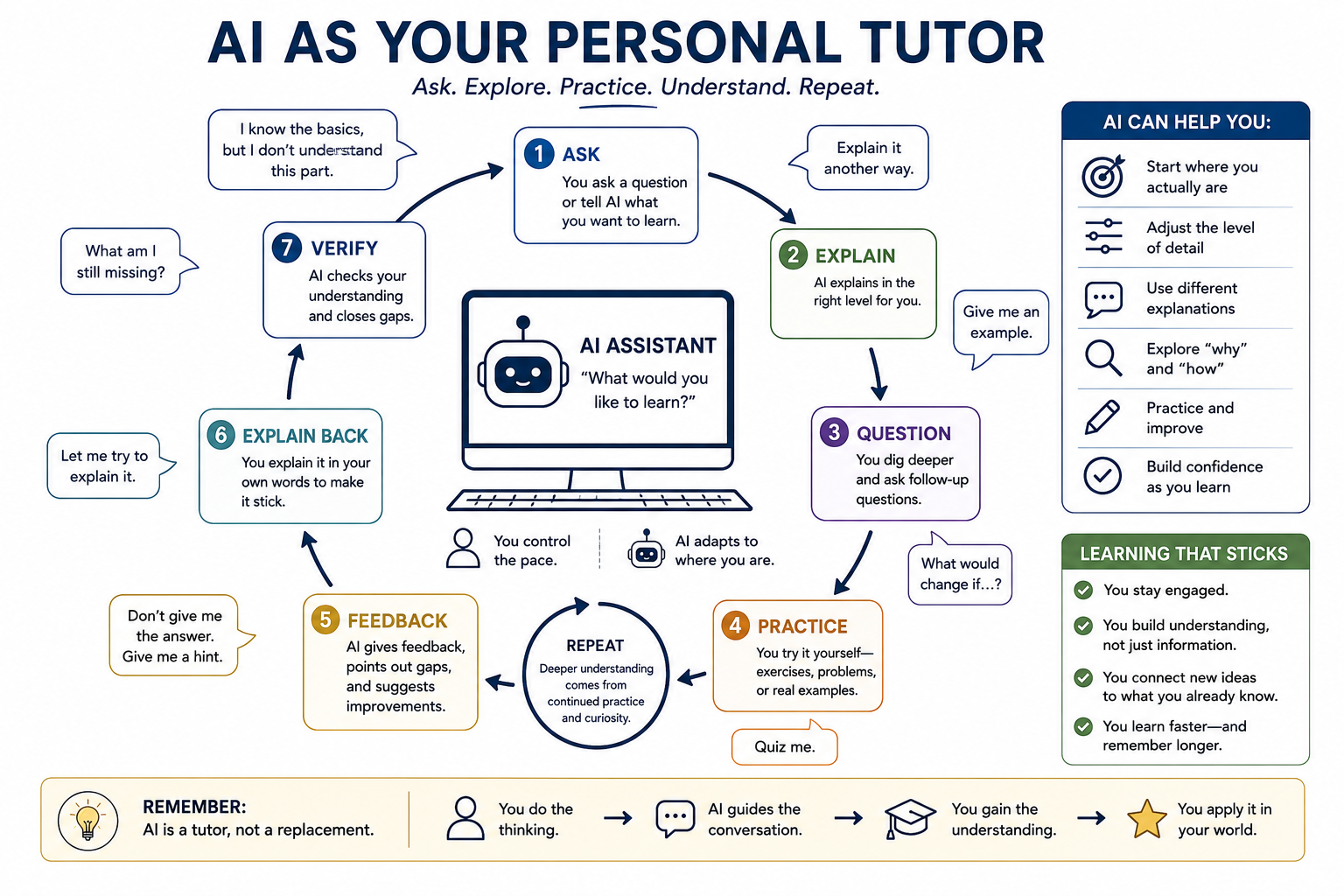
Ask AI to Be Your Tutor
You can explicitly ask AI to teach rather than simply answer.
Try:
"Act as my tutor."
"Teach me this subject one lesson at a time."
"Ask me questions rather than giving me the answer."
"Give me a short quiz after each section."
"Don't move on until I can explain the concept in my own words."
That changes the interaction from information delivery to active learning.
There is a difference between recognizing an explanation and being able to explain the idea yourself.
AI can help you test that difference.
Don't Let AI Do All the Thinking
Getting an answer quickly can create a problem.
If you ask AI every question and accept every explanation without trying to reason through the problem yourself, you may become better at getting answers without becoming better at thinking.
Try giving AI a different instruction:
"Don't give me the answer yet. Ask me questions that help me work it out."
Or:
"Give me a hint, not the solution."
Or:
"Quiz me before you explain it."
AI can serve as a tutor without becoming a substitute for the learner.
Learn by Doing
AI can be especially useful when learning requires practice.
You can use it to practice:
writing
coding
mathematics
languages
presentations
spreadsheets
AI prompting
Instead of asking AI to produce the finished work, ask it to help you improve your own work.
For example:
"Here is the paragraph I wrote. Don't rewrite it for me. Tell me the three biggest problems and let me try to fix them."
Then:
"Give me a similar exercise so I can practice the same skill."
That creates a cycle of practice, feedback, revision, and another attempt.
Ask for Another Explanation
Sometimes the problem isn't the subject.
It's the explanation.
If the first explanation doesn't work, ask for another.
Try:
"Explain it without technical terms."
"Explain it with an example."
"Explain it as a sequence of steps."
"Give me a visual description."
"Explain the common misunderstanding."
"Now give me the expert version."
There is no reason to remain stuck with one explanation.
A good learning conversation can change its approach until something clicks.
Explain It Back
One of the best tests of learning is being able to explain the idea yourself.
After AI teaches you something, try:
"Ask me to explain this in my own words."
Then let the assistant examine your explanation.
You might discover that you understand most of the concept but have one important part wrong.
That is useful information.
Another explanation may give you temporary familiarity.
Explaining the idea yourself tests whether you actually learned it.
Use More Than One AI
Different AI assistants can explain the same subject differently.
One may give you a concise explanation.
Another may offer a better example.
Another may challenge an assumption you didn't realize you were making.
You don't have to decide which assistant is the winner.
You can use the differences as part of the learning process.
Ask two assistants the same question.
Then ask:
"Compare these explanations. Where do they agree? Where do they differ? Which explanation is clearer, and why?"
The comparison itself can teach you something.
Connect New Ideas to What You Already Know
New information can be easier to retain when it connects to something familiar.
Tell AI what you already know.
Try:
"Explain this in terms of something I already understand."
For example:
"I understand how spreadsheets work. Explain databases by comparing the concepts that overlap and the ones that differ."
The assistant can start from your existing knowledge rather than assuming you are starting from zero.
That is another advantage of a conversational learning process.
Verify What Matters
AI can help you learn a subject by suggesting concepts, questions, research paths, and sources.
You can ask:
What are the important concepts I should understand?
What terms should I learn?
What are the competing explanations?
What do experts disagree about?
What has changed recently?
What do beginners commonly get wrong?
What primary sources should I read?
But learning from AI does not mean accepting every statement it produces.
When the subject matters, check important claims against reliable sources.
The goal is learning, not simply accumulating plausible explanations.
A Personal Learning Loop
A simple AI learning cycle might look like this:
ASK
Ask a question at your current level.
EXPLAIN
Have AI explain the concept.
QUESTION
Ask about what you don't understand.
PRACTICE
Try an exercise or apply the idea.
FEEDBACK
Have AI identify what you got right and what needs work.
EXPLAIN BACK
Describe the idea in your own words.
VERIFY
Check important facts against reliable sources.
REPEAT
Return to the parts that still aren't clear.
The sequence is more valuable than any individual prompt.
You can make the cycle short or continue it as long as the subject requires.
Use the Time AI Gives You Back
AI can reduce the time required to find, organize, and explain information.
What do you do with that time?
You can explore subjects that once seemed too difficult.
You can ask questions you might have been reluctant to ask in a classroom.
You can practice without worrying about slowing anyone else down.
You can return to the same concept as many times as necessary.
You can learn at your own pace.
Maybe some of the time AI gives us back should go to curiosity.
Try It Today
Choose a subject you've always wanted to understand better.
Tell AI:
What you already know.
What you don't understand.
How you would like to learn.
Then ask:
"Teach me one step at a time. Ask me questions along the way, and don't give me the answer when I can work it out myself."
See where the conversation takes you.