

PART III — Becoming an Effective AI User
Book 14
Making Better Decisions
AI Can Help You Think Through a Decision
AI can give you a recommendation in seconds.
That doesn't mean you should take it.
A recommendation is an input to a decision. It isn't the decision itself.
I've found that AI becomes more useful when I stop asking:
"Which one should I choose?"
and start asking:
"Help me understand the decision."
That small change can turn AI from a recommendation machine into a thinking partner.
Start With the Decision
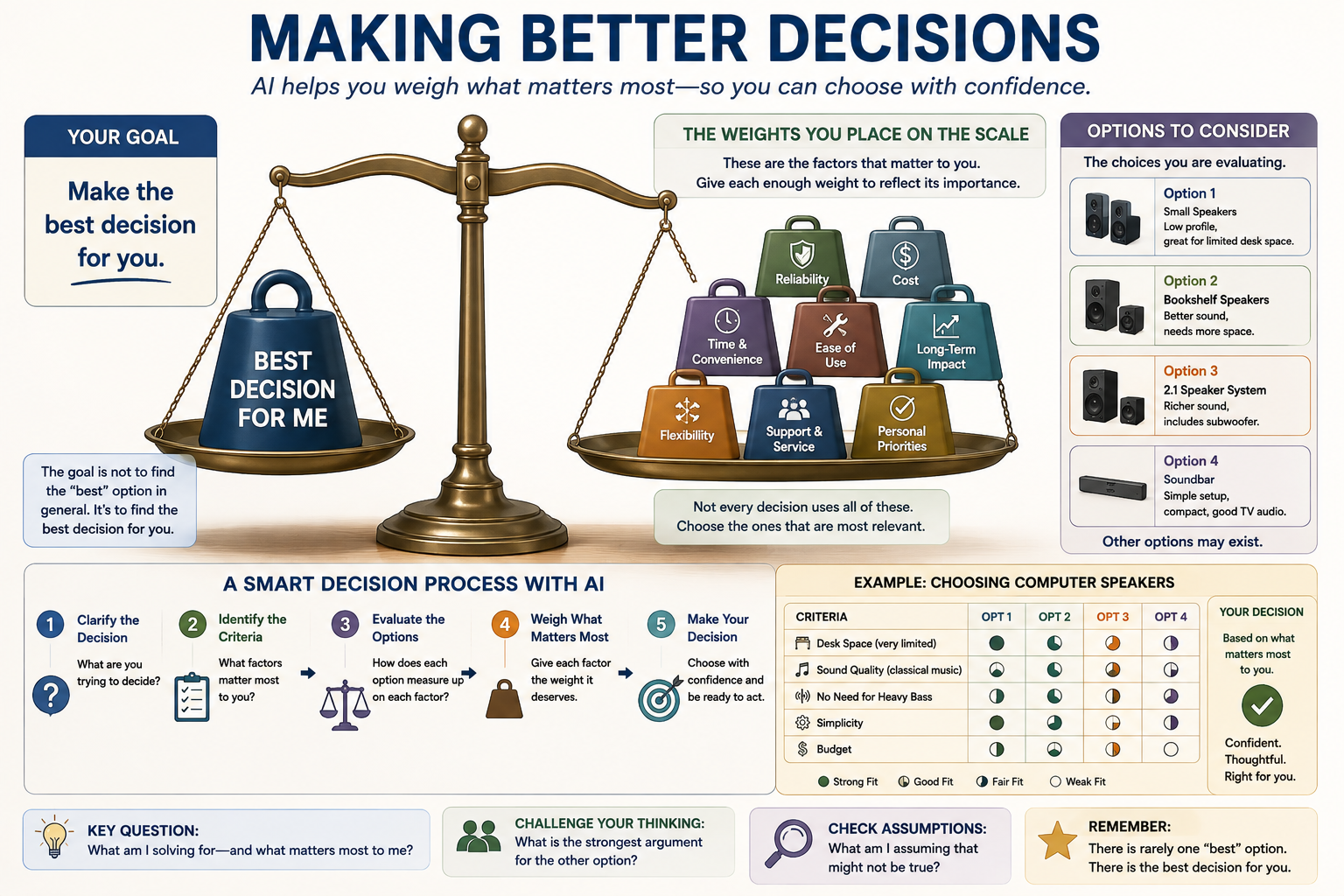
Before asking AI to choose between two options, ask it to help identify what actually matters.
Cost may matter.
Reliability may matter more.
Long-term maintenance, flexibility, time, ease of use, or other factors may matter too.
The point is to establish the criteria before asking for a winner.
Try asking:
"Before you recommend an option, help me identify the criteria I should use."
Now the recommendation has a basis.
Separate Facts From Judgment
Some parts of a decision are factual.
Other parts depend on what you value.
"The system costs $500 more" is a factual question.
"Is it worth paying $500 more?" is a judgment.
Ask AI to separate the two.
Try asking:
"Which parts of your recommendation are based on facts, and which parts depend on my preferences?"
Then ask:
"What assumption are you making about what I value?"
That can reveal something a polished recommendation can hide: the difference between information and judgment.
Look at the Trade-Offs
A good decision rarely has one option that is better in every respect.
One choice may be cheaper.
Another may be more reliable.
One may be easier to learn.
Another may offer more flexibility.
Ask AI to show you what you gain and give up with each option before asking for a recommendation.
Try asking:
"Compare these options. Don't tell me which one is best yet. Show me the trade-offs."
Then:
"What information would change that assessment?"
The recommendation can come after the analysis.
That order matters.
Challenge the Choice You're Leaning Toward
If you already prefer one option, ask AI to make the strongest case for the other.
"What is the strongest argument against the choice I'm leaning toward?"
You can then ask what evidence would make that argument stronger.
The goal isn't to make AI disagree with you.
The goal is to make it harder for the conversation to become an exercise in confirming what you already believe.
Ask Whether You're Solving the Right Problem
Sometimes the best decision isn't choosing between A and B.
It is deciding whether A or B is necessary at all.
You might spend an hour comparing two software packages when the better question is:
"Can my current software handle this if I change my workflow?"
That question could save more time and money than choosing between the two products.
Before solving a problem, ask AI:
"Am I solving the right problem?"
Expose the Assumptions
Every decision contains assumptions.
You may assume prices will remain stable.
You may assume you'll use something for several years.
You may assume a particular feature will matter.
Ask:
"What am I assuming that might not be true?"
Then:
"Which assumption is most likely to change the decision?"
That can be more useful than another page of pros and cons.
Let AI Improve the Process, Not Own the Decision
AI can:
organize information
compare options
identify trade-offs
expose assumptions
challenge your thinking
make a recommendation
You still have to decide what matters to you.
A recommendation can be logically consistent and still be wrong for your circumstances.
The goal isn't to have AI make the decision.
The goal is to use AI to help you make a better decision yourself.
A Better Decision Conversation
When a decision matters, try this sequence:
1. Define the decision.
"Here is the decision I'm facing."
2. Identify your priorities.
"These are the things that matter most to me."
3. Identify the constraints.
"These are the limits I have to work within."
4. Find the missing information.
"What information would help us evaluate this better?"
5. Examine the trade-offs.
"What do I gain and give up with each option?"
6. Expose the assumptions.
"What are we assuming that might not be true?"
7. Challenge your preferred choice.
"Make the strongest case for the option I'm least inclined to choose."
8. Ask what could change the conclusion.
"What evidence would change your recommendation?"
9. Ask for the recommendation.
"Now give me your recommendation, with the reasons and uncertainties clearly separated."
10. Verify before acting.
"What should I verify before I act?"
Notice the sequence.
The recommendation comes last.
Try It Today
Take a decision you're facing.
Before asking AI what you should do, ask it to help you:
define the decision
identify your criteria
separate facts from preferences
expose your assumptions
compare the trade-offs
challenge the choice you're leaning toward
Then ask for its recommendation.
You may find that the most valuable part wasn't the recommendation.
It was the conversation that led to it.