

PART III — Becoming an Effective AI User
Book 11
Getting Better Answers Through Better Conversations
The First Answer Is Rarely the Whole Conversation
One of the first things I noticed after I began using AI was that my best results rarely came from my first question.
That wasn't because the first question was bad.
It was because I didn't always know exactly what I wanted until I saw the first answer.
That may sound strange at first. We are accustomed to thinking of a question as something that has an answer. We ask, we receive the answer, and we move on.
Conversation works differently.
When you talk with another person about something complicated, the first answer often gives you a better idea of what you really want to know. You hear something that interests you, something you don't understand, or something that makes you realize you left out an important part of the question.
You ask again.
The conversation gets better.
AI can work the same way.
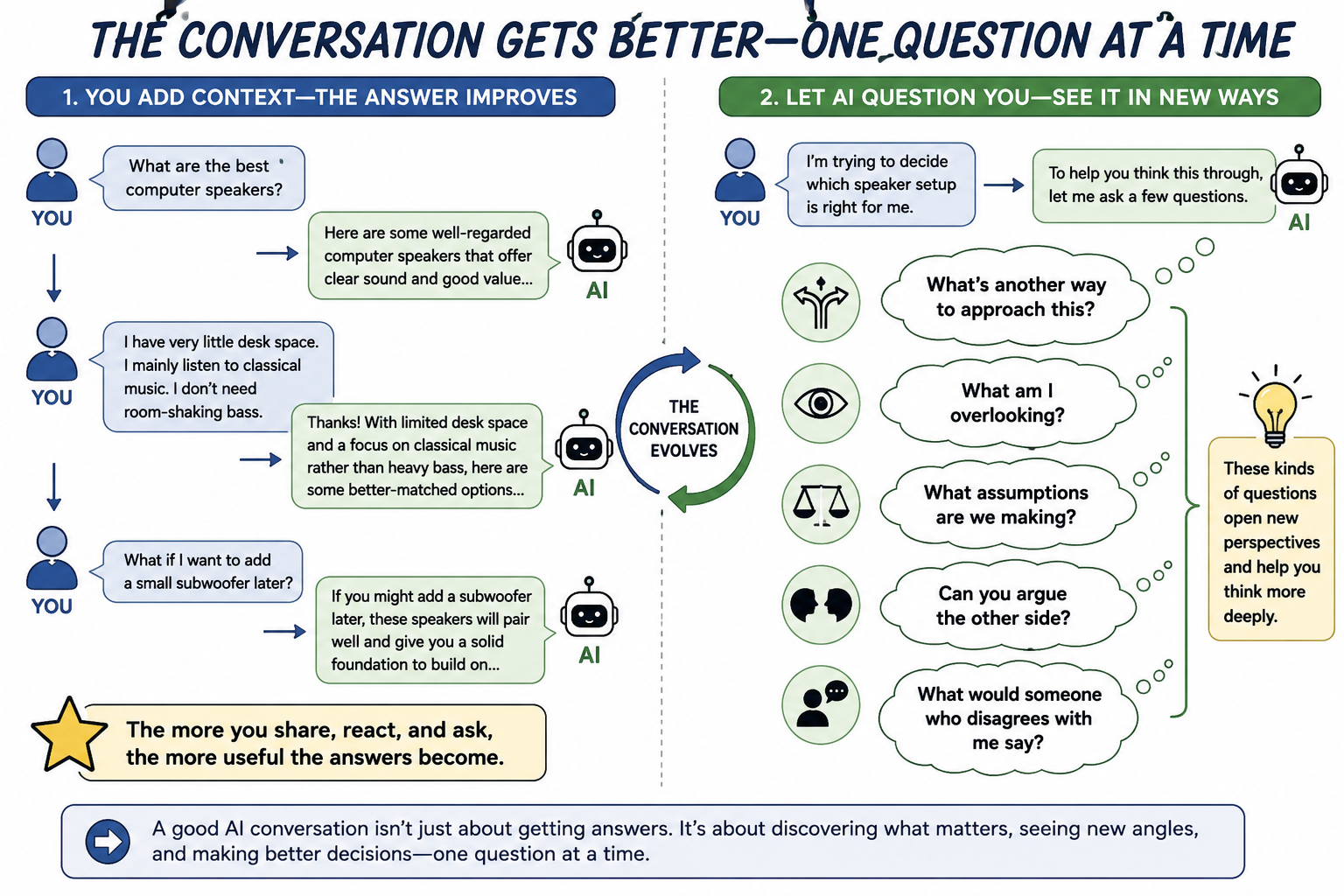
A Question I Asked About Computer Speakers
I learned this in a very ordinary way.
One day I asked AI to recommend computer speakers.
The answer was reasonable. It listed well-regarded speakers, described their features, and gave me the sort of information you might expect from a general product review.
But it wasn't particularly useful to me.
Then I realized why.
I hadn't told AI much about me.
I had very little desk space. I listened primarily to classical music. I wasn't looking for room-shaking bass.
So I added that information.
The recommendations changed.
Suddenly, AI wasn't answering the general question, "What are the best computer speakers?"
It was answering my question:
"What speakers make sense for someone with my desk, my listening habits, and my priorities?"
That experience reinforced something I had already begun to discover.
Sometimes the best way to improve an AI answer isn't to write a more elaborate first prompt.
It's to have the next conversation.
Ask the AI to Question You
There's another step that can make a conversation even better.
Instead of assuming that you have provided everything the AI needs, ask it what it needs to know.
"What information would help you give me a better answer?"
That's a remarkably useful question.
Suppose you're asking for help planning a trip. The AI might ask about the dates, budget, interests, transportation, or who is traveling.
Suppose you're trying to choose a computer. It might ask what programs you use, how much storage you need, and whether portability matters.
Suppose you're trying to learn something unfamiliar. It might ask what you already know.
You don't have to anticipate every relevant detail yourself.
You can ask the AI to help identify the missing details.
Ask for Another Way to See It
Sometimes the problem isn't that the answer is wrong.
It's that you haven't seen the issue from enough angles.
One of the habits I've found useful is asking AI to give me another perspective.
"What's another way to approach this?"
"What am I overlooking?"
"What assumptions are we making?"
"Can you argue the other side?"
"What would someone who disagrees with me say?"
Those questions can change the nature of the conversation.
The AI is no longer simply supplying information.
It is helping you examine your own thinking.
That doesn't mean you should automatically accept the alternative it gives you.
The purpose is to make sure you have considered possibilities you might otherwise have missed.
Don't Be Afraid to Challenge the Answer
There's another habit worth developing.
Challenge AI.
If an answer doesn't sound right, say so.
If you think an assumption is wrong, point it out.
If the recommendation seems too broad, ask for something more specific.
If two parts of the answer appear to contradict each other, ask about the contradiction.
And if the answer seems unusually confident, ask what evidence supports it.
The goal isn't to argue with the machine.
The goal is to make the conversation more useful.
A good AI conversation isn't one in which the AI always agrees with you.
Sometimes the most useful response is the one that makes you stop and think.
The News Provides a Good Example
I've found this especially useful when asking AI about current events.
I don't want only a summary of what happened.
I may want to know where the information came from, which facts appear well supported, whether reputable sources disagree, and what additional evidence might change the conclusion.
Those follow-up questions don't guarantee that the final answer will be correct.
They do something else that is just as valuable.
They keep me from becoming a passive recipient of the first answer.
That distinction matters.
AI can make it very easy to receive information.
Good conversation makes it easier to think about that information.
The Conversation Can Get Better One Question at a Time
Think back to the early chapters of this book.
We started with the idea that AI isn't a vending machine. You don't put a question in and simply wait for the answer to drop out.
A useful conversation develops.
You ask.
AI responds.
You react.
You add context.
AI adjusts.
You question something.
AI explains.
You discover another issue.
The conversation continues.
This may sound almost too simple to deserve a chapter.
But it is one of the biggest changes in thinking required to become comfortable with AI.
You don't have to know everything before you begin.
You can discover what you need to know through the conversation itself.
One of My Favorite Questions
If you take only one practical question from this chapter, I would make it this:
"What important question haven't I asked yet?"
I like this question because it changes the conversation from answering the question I thought to ask into helping me discover what else matters.
It can expose missing information.
It can reveal assumptions.
It can suggest a next step.
It can even tell you that you are asking the wrong question.
And sometimes that is the most useful answer of all.
A Small Experiment
Try this with a question you've already asked an AI assistant.
Find one where the answer was acceptable but not particularly useful.
Now continue the conversation.
Tell the AI what was missing.
Ask what information would help it improve the answer.
Ask what assumptions it made.
Ask what you might have overlooked.
Then ask for a revised answer.
Don't compare only the first and second answers.
Compare the conversations.
You may find that the difference is much larger than you expected.
That is the point.
You are learning that a useful AI conversation is something you build.
And the Conversation Can Grow Beyond You
So far, we've been talking about questions you ask for yourself. But imagine that instead of asking about your own photographs, speakers, travel plans, or decisions, you were responsible for a business.
You might want AI to examine sales information, customer feedback, operating costs, inventory, or market research. You might want it to look at the same problem through several analytical approaches and help identify questions you hadn't considered.
Now the nature of the AI relationship begins to change.
A business may have its own information, its own rules, its own processes, and its own accumulated knowledge. It may want an AI system that can work with that information without simply sending sensitive company material to a public AI service. That opens the door to private or internally controlled AI systems, where an organization can bring its own information and policies into the AI environment.
And the analytical side can become much more sophisticated, too. Instead of simply asking, "What do you think?" a business might ask AI to examine a problem using a SWOT analysis, a decision matrix, a risk analysis, a cost-benefit analysis, or several frameworks side by side.
We aren't going there yet.
For now, I want you to recognize the possibility. The conversation we've been learning to have with AI can grow from an individual's question into a way of working with information, analyzing problems, and making decisions across an organization.
We'll come back to that later.
Take This With You
You don't need the perfect prompt.
You need enough of a starting point to begin a useful conversation—and the curiosity to keep going.