

Root-Cause Analysis
A way to investigate the underlying causes of a problem
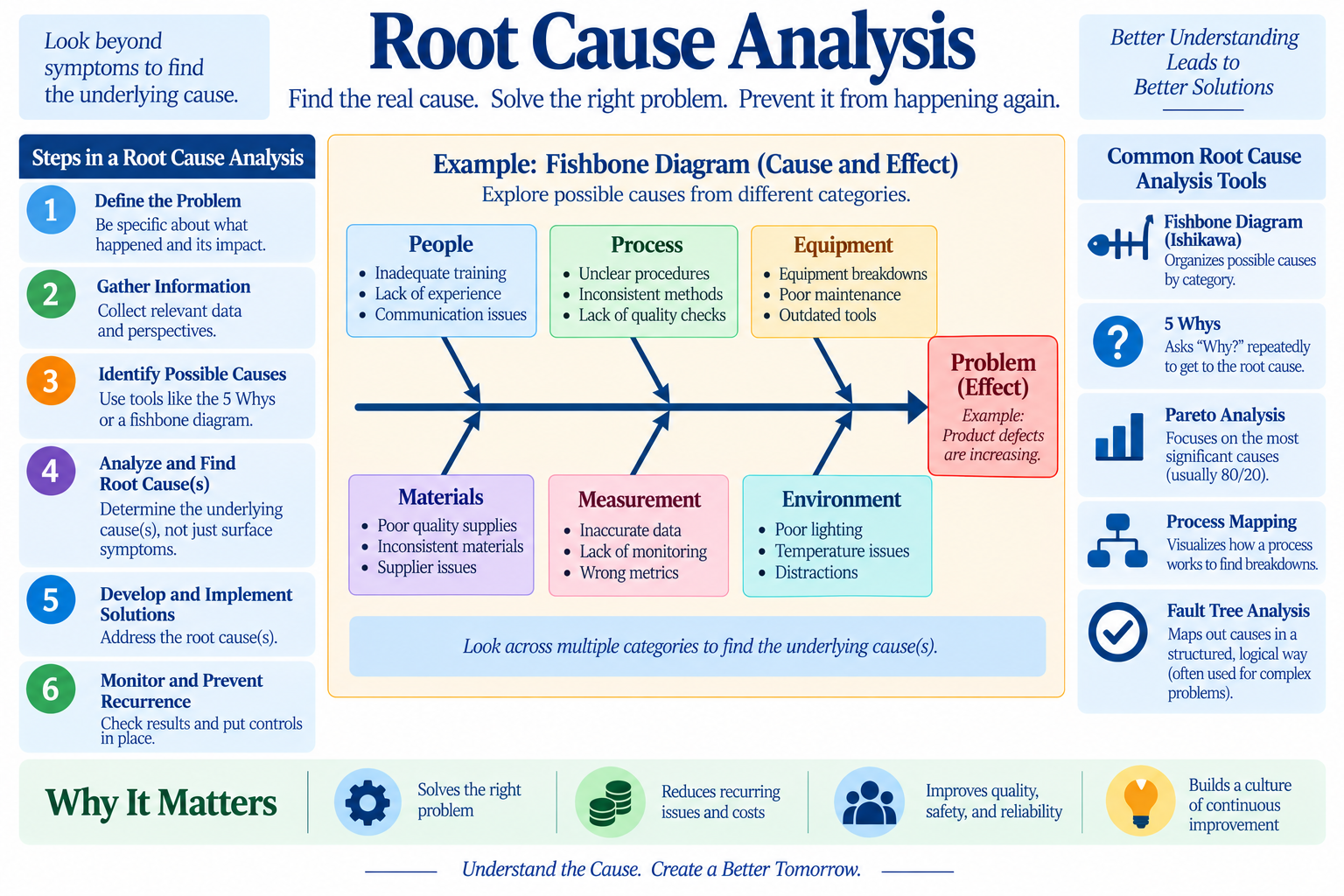
Root-Cause Analysis (RCA), sometimes associated with an Ishikawa diagram or fishbone diagram, is a broader approach to investigating why a problem occurred.
Unlike Five Whys, which follows a chain of questions, Root-Cause Analysis can examine multiple possible causes and contributing factors at the same time.
AI can help you organize possible causes, identify relationships among them, challenge assumptions, and suggest information that could help determine which causes are most likely.
When to use it
Use Root-Cause Analysis when:
a problem has several possible causes
the immediate cause does not explain the whole problem
you need to examine contributing factors
a problem has happened repeatedly
you want to distinguish symptoms from underlying causes
you need a broader analysis than a single chain of “why?” questions
Try this with AI
Help me conduct a Root-Cause Analysis of [problem]. Identify the immediate problem, possible underlying causes, and contributing factors. Group related causes and show how they may be connected. Distinguish evidence from assumptions, identify competing explanations, and point out information that would help determine which causes are most likely. Do not assume there is only one root cause.
Then ask a follow-up
Which possible causes have the strongest evidence? Which depend most on assumptions? What information or tests would help me determine which causes are actually contributing to the problem?
You can then ask AI to organize the causes as an Ishikawa or fishbone diagram, or examine one group of causes in greater detail.
A useful caution
Finding a possible cause is not the same as proving that it caused the problem.
AI may create plausible connections between events that are not actually related. It may also label something a “root cause” when it is only one contributing factor.
Ask AI to show the evidence for each important cause. Test the leading explanations rather than accepting the first plausible explanation.
Remember
Root-Cause Analysis helps you examine multiple possible causes of a problem. A plausible cause still needs evidence before you treat it as the cause.