

Gartner Hype Cycle
A way to examine how expectations about a new technology change over time
The Gartner Hype Cycle is a model for looking at how expectations about a new technology may change over time. A technology may attract great excitement early on, encounter disappointment when its limitations become clearer, and later move toward more practical use.
The model has five stages:
Innovation Trigger — a new technology or idea begins attracting attention.
Peak of Inflated Expectations — excitement and expectations become very high.
Trough of Disillusionment — interest declines as limitations, problems, or unmet expectations become clear.
Slope of Enlightenment — practical uses become clearer and experience accumulates.
Plateau of Productivity — the technology becomes more established and its practical value is better understood.
The Hype Cycle is a way to think about expectations and adoption. It is not a prediction of exactly what will happen to a particular technology.
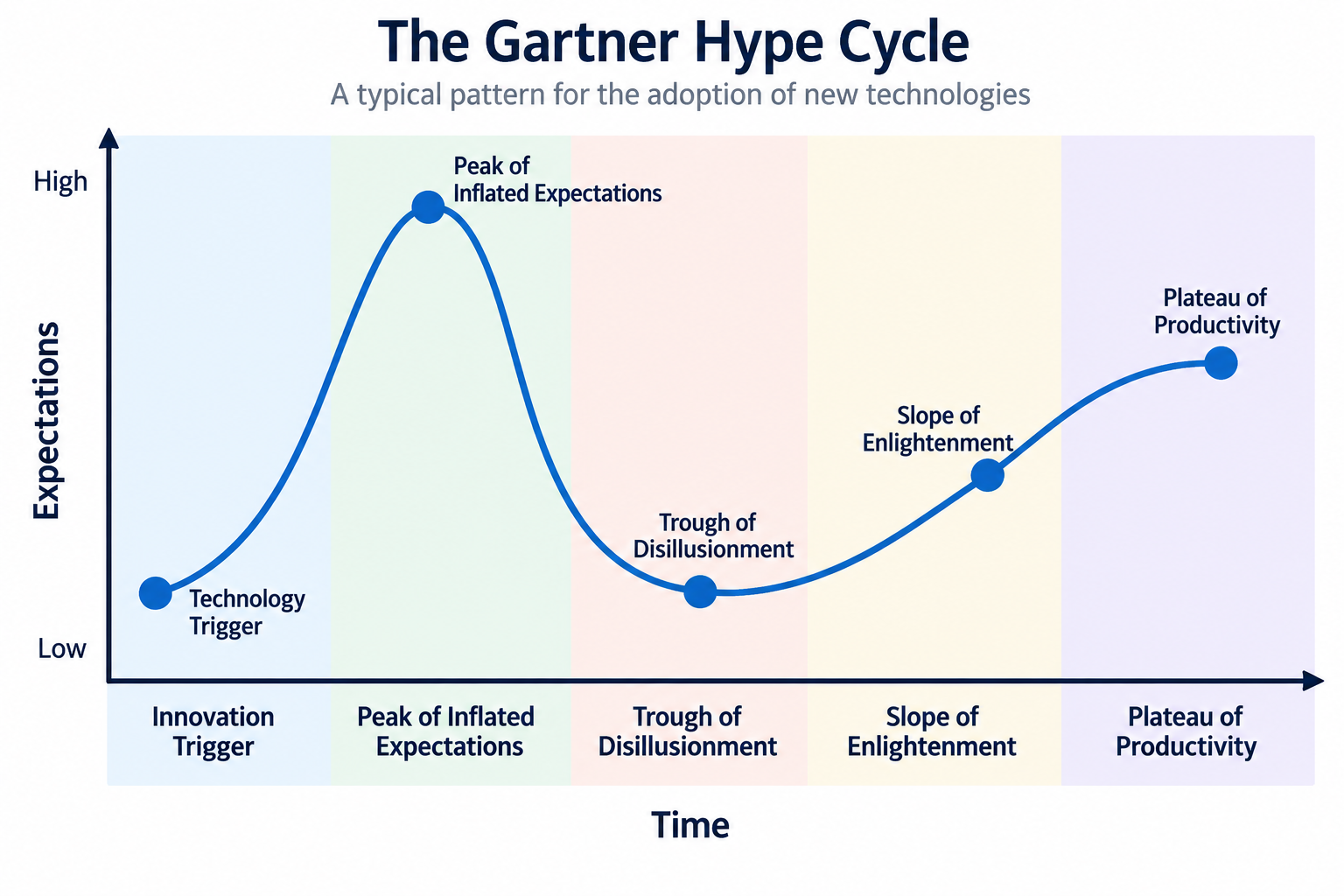
Figure: An illustrative Gartner-style Hype Cycle. The shape and timing vary from one technology to another.
Figure: An illustrative Gartner-style Hype Cycle. The shape and timing vary from one technology to another.
When to use it
Use the Hype Cycle when:
you want to examine where a new technology may be in its development or adoption
you are considering whether a technology is ready for practical use
expectations about a technology seem unusually high or low
you want to compare several emerging technologies
you want to separate excitement about a technology from evidence of its practical value
you want to think about what might happen as experience with a technology increases
What the stages mean
Innovation Trigger
A new technology, research result, product, or application begins attracting attention. Early demonstrations may be promising, but there may be little evidence about practical use at scale.
Peak of Inflated Expectations
Excitement grows. Success stories may receive more attention than failures or limitations. Expectations can become much higher than what the technology can currently deliver.
Trough of Disillusionment
Problems and limitations become more visible. Some uses fail to meet expectations, and interest may decline. This stage can provide useful information about what the technology can actually do.
Slope of Enlightenment
People begin to identify more practical applications. Experience, testing, and better information can lead to more realistic expectations.
Plateau of Productivity
The technology has established uses that provide practical value. Adoption may continue to grow, but expectations are generally more grounded in experience.
Try this with AI
Using the Gartner Hype Cycle as a framework, examine [technology]. What evidence suggests that it is currently receiving high, declining, or increasing expectations? Identify the practical uses that have been demonstrated, the limitations that have become apparent, and the uncertainties that remain. Distinguish evidence from predictions and speculation.
Then ask a follow-up
What evidence supports your assessment of where [technology] belongs on the Hype Cycle? What would cause you to place it at a different stage?
You can then ask AI to compare the technology with another emerging technology and explain why the two might be at different stages.
A useful caution
The Hype Cycle is a general model, not a precise forecast.
A technology does not have to pass through every stage in the same way. Some technologies may develop slowly without a dramatic period of inflated expectations. Others may attract enormous attention and then fail to achieve widespread practical use.
AI can make this problem worse by producing confident descriptions of where a technology belongs without enough evidence to support the placement.
Ask AI to show you the evidence behind its assessment. Check current information about the technology, its actual uses, adoption, limitations, and results.
Remember
The Hype Cycle helps you separate excitement about a technology from evidence of its practical value. It does not predict the future.