

Five Whys
A way to look past the immediate problem
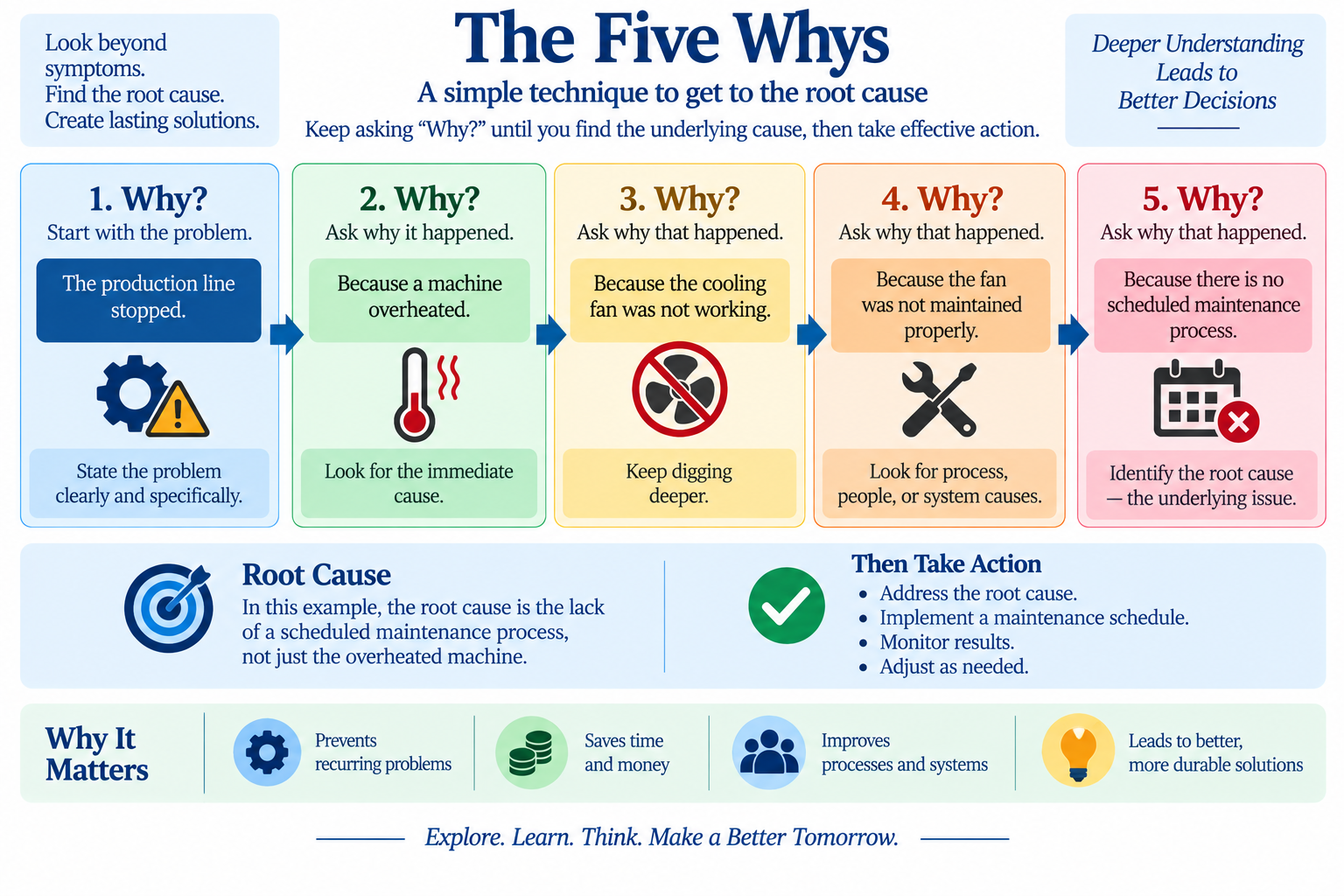
Five Whys is a simple technique for exploring why a problem occurred. You start with the problem and ask why? repeatedly, using each answer to form the next question.
The number five is a guide, not a rule. Some problems may require fewer questions; others may require more.
AI can help you work through the questions, challenge your answers, and identify places where the reasoning depends on an assumption.
When to use it
Use Five Whys when:
you are trying to understand why a problem occurred
the immediate problem may have a deeper cause
you want to move beyond symptoms
you need a simple way to investigate a recurring problem
you want AI to challenge your initial explanation
Try this with AI
Help me use the Five Whys method to investigate [problem]. Start with the problem as I have described it and ask why it happened. For each answer, ask whether it is supported by evidence or is an assumption. Continue until we reach a plausible underlying cause. If there are multiple possible causes, show them rather than forcing the analysis into one chain.
Then ask a follow-up
Which links in this chain are based on assumptions rather than evidence? What information would help me determine whether we have identified a real underlying cause?
You can then ask AI to examine another possible cause or suggest what information would help test the leading explanation.
A useful caution
Five Whys can create a convincing chain of reasoning even when one of the answers is wrong.
AI may accept an incorrect answer early in the process and build the rest of the analysis on it. Asking “why?” five times does not guarantee that you have found the real cause.
Check each important step. If there are several plausible causes, examine them rather than forcing the problem into a single explanation.
Remember
Five Whys helps you look beyond a symptom. It does not guarantee that the final “why” is the real cause.