

Costs-Benefits Analysis
A way to compare expected gains with expected costs
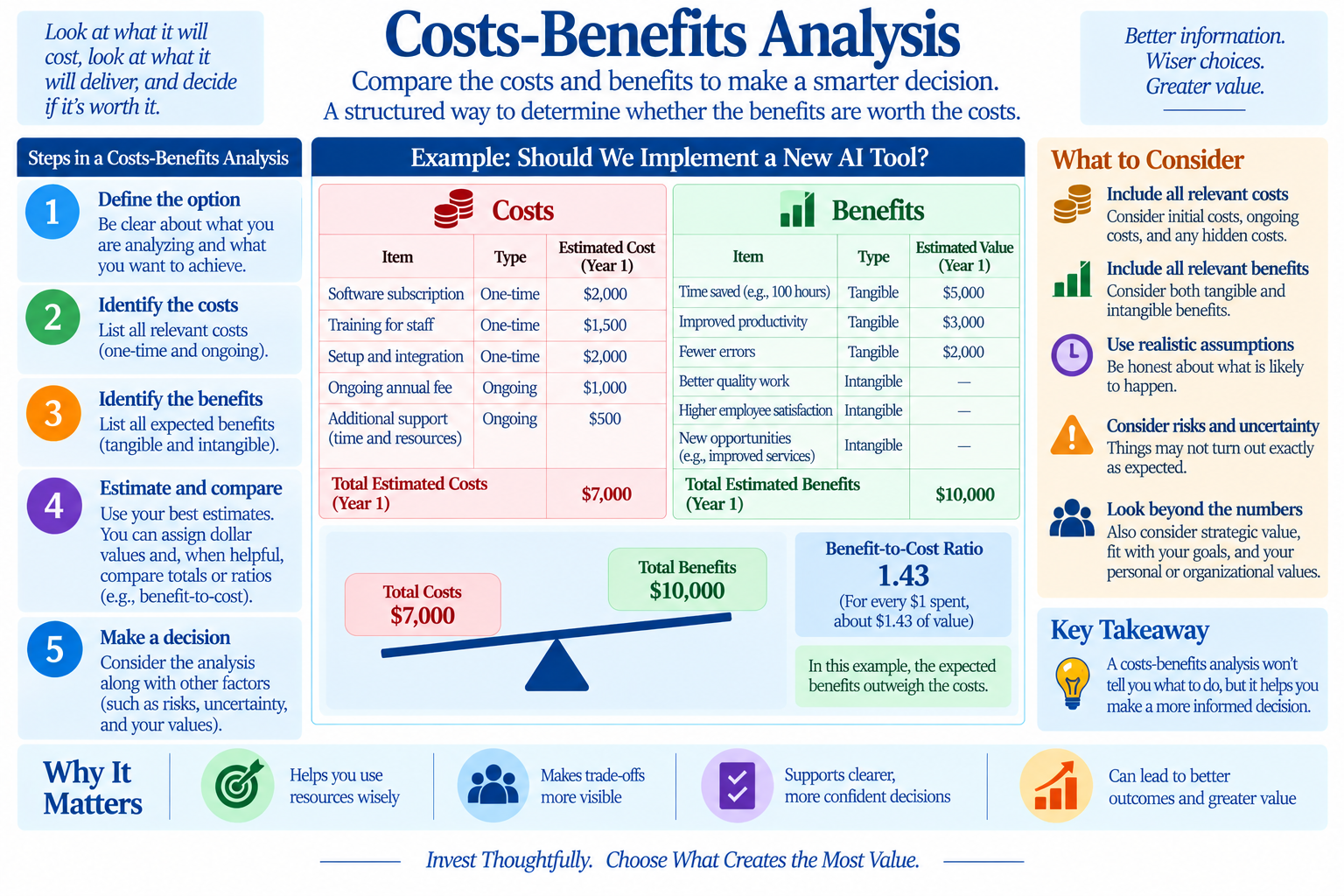
Cost-benefit analysis helps you compare what you expect to gain from a choice with what you expect to spend or give up.
The costs may be financial, but they can include time, effort, risk, inconvenience, or other resources. The benefits may be financial or nonfinancial.
AI can help you identify costs and benefits you may have overlooked, organize them, and examine how the result changes when your assumptions change.
When to use it
Use cost-benefit analysis when:
a decision involves meaningful costs and benefits
you want to compare the expected value of different choices
some costs or benefits are easy to overlook
you want to examine both financial and nonfinancial factors
you want to test how sensitive the decision is to your assumptions
Try this with AI
Help me conduct a cost-benefit analysis of [decision]. Identify the likely costs and benefits, including financial and nonfinancial factors. Separate known facts from estimates and assumptions. Identify costs or benefits that may occur later. Then compare the alternatives and show me which assumptions have the greatest effect on the result.
Then ask a follow-up
Which costs or benefits are most uncertain, and what information would be most useful to verify before I make this decision?
You can then ask AI to test different assumptions and show how the result changes.
A useful caution
A cost-benefit analysis can make difficult judgments look like simple arithmetic.
Some costs and benefits are easy to measure. Others are difficult to express in dollars or numbers. Time, convenience, risk, quality of life, and personal priorities may matter greatly even when they are difficult to quantify.
Don't let a calculated total hide an important factor that is difficult to measure.
Remember
A cost-benefit analysis helps you see what you may gain and what you may give up. You decide what those costs and benefits are worth.